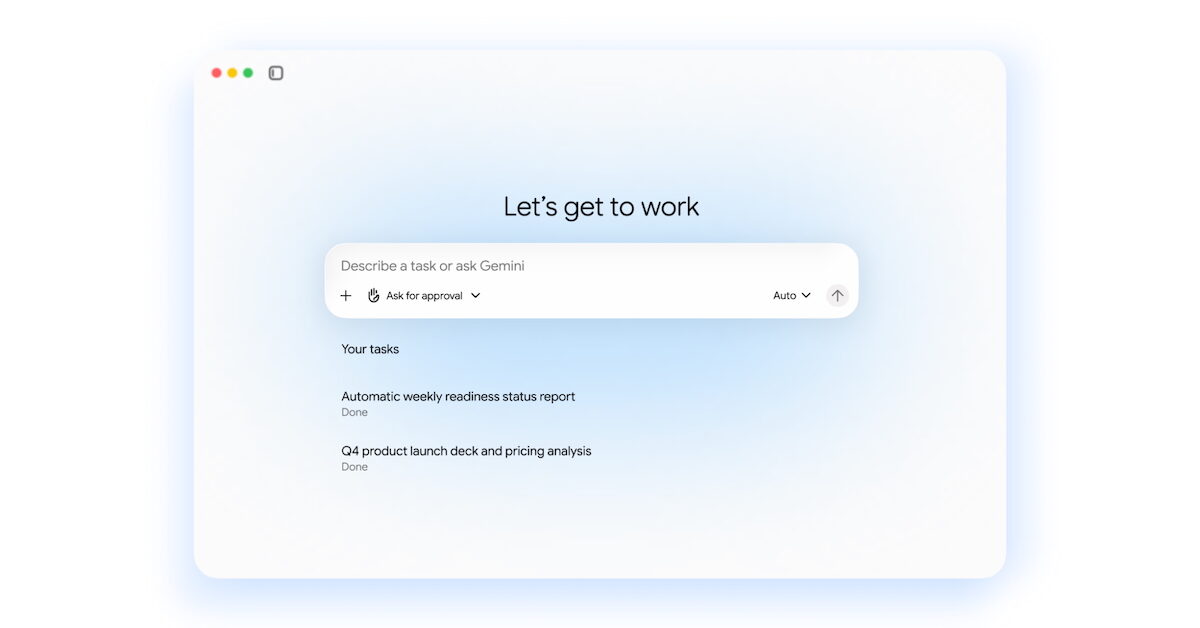
Google is radically transforming the way we work in business. During its keynote Gemini at Work 2026, Thomas Kurian, CEO of Google Cloud, introduced the Gemini agent, a revolutionary solution capable of conducting research, executing coding tasks, and managing complex workflows from a single interface and a single API. What particularly impresses me is that Google is abandoning the traditional approach of detailed instructions to adopt a more natural philosophy: you set a goal, and the agent organizes the work. This transition marks a major turning point in intelligent automation. The leader summarizes the ambition with an eloquent phrase: “Work now begins in the prompt window.” This approach fundamentally changes our relationship with productivity in business, and I will explain why this represents much more than just a technological update.
📋 Summary
An Agent that Works Continuously, Alone or in a Team
One of the most revolutionary features of the Gemini agent is its ability to operate autonomously and persistently. Unlike traditional tools that require constant intervention, this agent can execute delegated tasks that run for days without interruption. You close your computer, and the work continues in the cloud. This is a major transformation for teams managing complex projects. The agent automatically organizes the work, chooses its own tools and skills, and then connects to existing software or any MCP server. This flexibility 🔄 is remarkable as it adapts to your existing ecosystem rather than forcing you to change your habits.
For multi-step tasks, the agent creates temporary sub-agents, each with its own identity and responsibility. This distributed architecture allows for better management of complex workflows. The agent is not tied to a single model: it directs each task to either the Gemini models or the Claude models from Anthropic, a direct competitor of Google. This strategic openness shows that Google prioritizes efficiency over technological lock-in. The agent retains the same memory from one channel to another, from Microsoft 365 to Slack, meaning that context is preserved regardless of the platform used.
Google will roll out the agent by sector, with dedicated skills and connectors. In preview, you will find versions for finance and legal. Other sectors such as public, health, and retail are announced soon. This verticalized approach recognizes that each industry has specific needs. I believe this sector segmentation strategy will be crucial for the widespread adoption of these agents in business.

AI Colleagues with Their Own Workspace Account
What is truly fascinating about this announcement is the creation of AI colleagues with their own Workspace account. Google is not just offering a tool, but a true integration into the professional ecosystem. Each colleague agent receives a dedicated email address in the format @agents.company.com, a personal calendar, and a Drive space. This personalization 👥 creates a real digital presence for the agent within the organization. Collaborators can mention it in Chat or in a comment, and its modifications appear under its name in the version history.
In Workspace, the Gemini agent intervenes directly in emails and documents. It also suggests tasks to delegate intelligently. If a manager requests a progress update via email in the form of a presentation, a click is enough to assign it to Gemini. This native integration into daily tools makes adoption much more natural. The agent only accesses content shared with it, respecting security and privacy principles. This granular approach to permissions is essential for companies managing sensitive data.
I consider this approach of the agent as a true team member to be a paradigmatic shift. Rather than seeing AI as an external tool, companies can now integrate it as a virtual collaborator. Teams create a colleague agent by simply describing the expected role, and the system handles the rest. This simplicity of implementation could significantly accelerate the adoption of intelligent automation in organizations.
Security and Cost Control: Essential Safeguards
Google understands that for companies to widely adopt these agents, there must be robust safeguards on security. Every action of an agent is logged in an audit trail under its name, creating complete traceability. All traffic passes through Agent Gateway, a network firewall dedicated to AI that enforces company rules. This security architecture 🔐 is fundamental for organizations that must comply with strict regulatory standards. I believe this transparency and traceability will be decisive in convincing IT managers and compliance directors.
From a financial standpoint, Google offers a spending cap per project system. Administrators set a cap in the Google Cloud billing console, and once the threshold is reached, the agent pauses until manually restarted. This approach prevents uncontrolled budget overruns. With a 98% drop in the price per token since 2024, usage volumes are skyrocketing, and without these safeguards, AI bills could become unmanageable. This cost-limiting feature is particularly important for SMEs and startups that must manage their IT budgets rigorously.
The absence of precise pricing in the initial announcement is notable. Google has not yet communicated on pricing or the exact availability timeline for the Gemini agent. This temporary opacity is common for strategic products, but it creates some uncertainty for companies planning their AI investments. I expect the rates to be competitive, but likely based on a consumption model rather than fixed packages.
The Evolution of Gemini Enterprise: A Turn Towards Agentic
To understand the importance of this announcement, we must place the Gemini agent in the broader context of Google’s strategy. Google launched Gemini Enterprise in October 2025, a platform based on a catalog logic where companies create their own agents without code using Agent Designer. This platform absorbed Agentspace, consolidating Google’s approach around agents. The Gemini agent represents a major evolution of this strategy, moving from a modular approach to a more unified and intelligent approach.
On the consumer side, Google introduced Gemini Agent in November 2025, an experimental feature reserved for American AI Ultra subscribers. This progression from consumer to enterprise shows a well-thought-out strategy: testing concepts with early adopters before deploying them widely. The Gemini agent for enterprise thus benefits from months of feedback and improvements. I believe this iterative approach is much more effective than launching a complex solution directly without prior validation.
Google also justifies this approach by economies of scale and cost optimization. The company notes that nearly 80% of Google Cloud customers use its AI products, and nearly 90% of Fortune 100 companies use Gemini Enterprise. At this scale, organizations have moved beyond the experimentation stage and now rely on these solutions for their critical operations. The automatic model selection should reserve the most expensive for tasks that justify it, thus optimizing the cost-performance ratio. This market maturity explains why Google can now offer such an ambitious solution.
The Impact on Intelligent Automation and Productivity
The Gemini agent represents a turning point in how businesses can automate their processes. Unlike traditional automation solutions that require complex programming, this agent operates based on natural objectives. You can use intelligent automation tools without being a developer. This democratization of automation could transform business teams, making them more autonomous and productive. I see enormous potential for finance, human resources, and customer support teams that could automate repetitive tasks without relying on IT.
Integration with existing tools is crucial. The Gemini agent connects to Microsoft 365, Slack, and other platforms via MCP (Model Context Protocol). This open integration approach means you do not need to replace your existing tech stack. You can simply add the Gemini agent as a layer of automation. This compatibility significantly reduces adoption friction and migration costs. For companies with complex tech ecosystems, this is a major advantage. I highly recommend checking out our guide on the MCP protocol to understand how this integration works in detail.
I believe the real impact of the Gemini agent will be visible in the coming months, as the first production implementations demonstrate actual productivity gains. Obvious use cases include document management, data analysis, report generation, and task coordination between systems. But I suspect that the most innovative use cases will be discovered by the companies themselves as they experiment with this agent.

Future Perspectives and Strategic Issues
The announcement of the Gemini agent raises important questions about the future of work in business. If AI agents can manage complex tasks autonomously, how should organizations rethink their structures and processes? I believe we will see an evolution towards more strategic and creative roles, with agents managing repetitive and analytical tasks. This transition will require significant training and organizational adaptation.
Competition in the AI agent space is intensifying. OpenAI, Anthropic, and other players are also developing their own agent solutions. Google has the advantage of controlling a massive cloud platform and a suite of business tools (Workspace), giving it a privileged position. However, Google’s openness to using Anthropic’s Claude models shows a certain technological humility. I believe this pragmatic approach, where the best tool wins, will be beneficial for customers. To learn more about the different approaches to AI agents, check out our article on collaboration between intelligent agents.
The lack of precise pricing and availability timeline remains a question mark. Google will need to communicate clearly on these elements for companies to plan their investments. I expect the first deployments to begin in the preview sectors (finance and legal) before a gradual rollout. The key to success will be demonstrating a clear and measurable ROI to justify widespread adoption.
Conclusion
Google’s Gemini agent represents a major step in the evolution of intelligent automation in business. What impresses me most is the underlying philosophy: rather than forcing users to learn a new interface or programming language, Google offers a natural goal-based approach. You state what you want to achieve, and the agent organizes the work. This apparent simplicity hides considerable technological complexity, but it is precisely what makes this solution so powerful. The integration with Workspace, robust security, and financial safeguards show that Google has thought about enterprise adoption holistically.
I believe we are on the brink of a major transformation in business work. Organizations that quickly adopt these agents will have a significant competitive advantage in terms of productivity and efficiency. However, success will also depend on companies’ ability to adapt their processes and teams to this new reality. The Gemini agent is not a magic solution, but a powerful tool that, when used correctly, can free teams from repetitive tasks and allow them to focus on high-value work. The coming months will be decisive in seeing how the market adopts this technology and which use cases emerge as the most impactful.
📝 In Brief
- The Google Gemini agent operates autonomously and persistently, capable of executing complex tasks for days without interruption
- Each colleague agent receives its own Workspace account with email, calendar, and Drive space, integrating naturally into teams
- Google offers robust safeguards in terms of security (audit trail, dedicated firewall) and cost control (spending cap per project)
- The agent adapts to your existing ecosystem via MCP and supports both Gemini and Claude models, offering maximum flexibility