For several years now, I have observed a major transformation in the way AI models interact with our professional tools. Assistants like ChatGPT, Claude, or Gemini possess impressive capabilities in writing, analysis, and synthesis. However, they suffer from a fundamental limitation: their knowledge is limited to their training date, and they cannot, on their own, query a database, check a calendar, or trigger an action in third-party software. This is precisely the lock that the Model Context Protocol (MCP) aims to break. Created by Anthropic and quickly adopted by industry giants like OpenAI, Google, and Microsoft, the MCP represents a silent yet profound revolution in the AI ecosystem. It is an open-source protocol that provides a universal standard allowing AI models to connect to data sources and external tools in a unified and secure manner. In this article, I propose to decode this protocol, explore its concrete functioning, and understand how it will transform your professional daily life.
📋 Summary
A Universal Language to Connect AI to External Tools
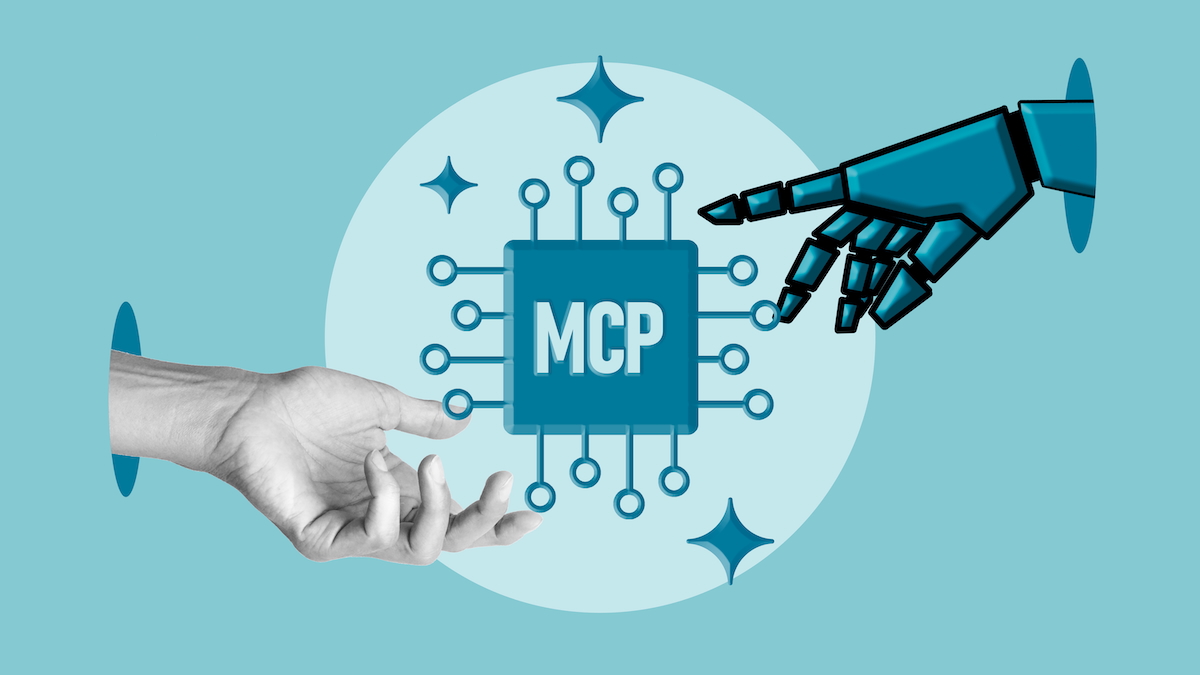
The MCP is an open-source protocol introduced by Anthropic in November 2024. Its fundamental role is to provide a universal standard for AI models to connect to data sources and external tools (databases, CRMs, cloud services, collaborative platforms) in a unified and secure manner. Before the MCP, each connection between an AI model and an external service required a custom connector. Multiplied by the number of models and tools on the market, this created a real integration puzzle that developers refer to as the “N×M problem”: N models to connect to M tools, with as many specific connectors to build and maintain. It’s a bit like if each electronic device needed its own unique cable 🔌 instead of using a standardized plug.
The MCP replaces this complex mechanism with a single interface, often compared to a “USB-C of AI.” This analogy is particularly relevant: just as USB-C has unified connectors for electronic devices, the MCP creates a single connection standard compatible with all AI models and all tools. Since its launch, the protocol has been adopted by major industry players. OpenAI, Google, Microsoft, as well as platforms like Figma, Replit, and Sourcegraph have integrated it into their environments. This massive adoption makes it today a de facto standard in the AI ecosystem.
I must emphasize that this standardization represents a major turning point for the industry. Before the MCP, companies had to invest heavily in custom integrations, which slowed down innovation and increased costs. With the MCP, developers can focus on creating value rather than on technical plumbing. This is a change that benefits all players in the ecosystem, from startups to large enterprises. The universal compatibility of the protocol means that tools developed today will remain relevant tomorrow, regardless of the evolution of AI models.

How the MCP Protocol Works in Practice
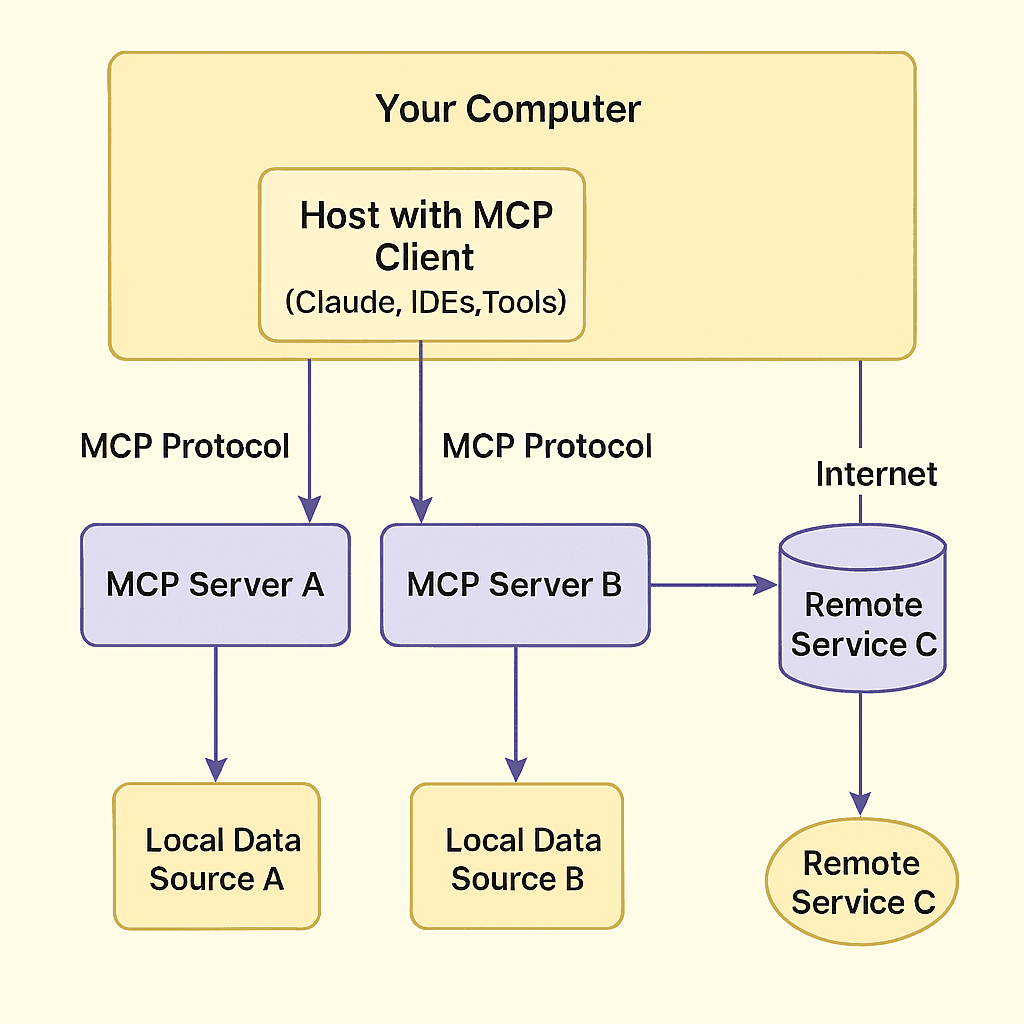
The architecture of the MCP relies on three essential components that work together harmoniously. The first is the host, which is the application in which the AI model runs (a chatbot, an IDE, an integrated assistant). The second is the MCP client, integrated into this host, which translates the model’s requests into the protocol’s language. The third is the MCP server, on the external service side, which receives these requests and responds to them. This three-layer architecture creates a clear separation of responsibilities 🏗️ and allows for smooth communication between the AI and external tools.
Let’s take a concrete example to better understand. You ask an AI assistant: “Find the latest sales report in our database and send it to my manager.” The model alone cannot do that. But thanks to the MCP, it identifies two available tools (a database connector and an email sending tool), queries the first to retrieve the report, and then requests the second to send it. All of this happens through a standardized exchange, without the developer having to code a specific connector for each service, or the user having to perform other actions. It’s a seamless and efficient automation.
This functioning distinguishes the MCP from another known approach, RAG (Retrieval-Augmented Generation), which is limited to injecting documents into the model’s context. The MCP goes further, as it not only provides information but also allows the model to act (send a message, create an event, modify a file). It is this capacity for action that makes the MCP so powerful for professionals. I consider it the key difference between a passive assistant and a true autonomous agent capable of transforming your workflow.
MCP vs RAG: Understanding the Essential Differences
The distinction between the MCP and RAG is fundamental to understanding the evolution of professional AI. RAG (Retrieval-Augmented Generation) allows an AI model to consult documents to enrich its responses. It is a passive approach: the AI reads information and uses it to generate a more relevant response. For example, if you ask a RAG assistant to summarize last month’s sales, it will search for the relevant documents and provide you with a summary based on that information 📚. It’s useful, but limited.
The MCP, on the other hand, offers an active approach. It does not just provide information to the model; it allows it to act directly on your systems. With the MCP, you can ask your AI assistant not only to find sales data but also to create a report, send it to your manager, and even update your CRM with the relevant information. This is a major difference that transforms AI from a consulting tool into a true execution agent.
I must clarify that these two approaches are not mutually exclusive. In reality, the most powerful systems combine RAG and MCP. RAG enriches the model’s context with relevant information, while MCP allows it to act based on that information. It is this synergistic combination that creates the most effective AI assistants. Understanding this distinction is crucial for evaluating the actual capabilities of the AI tools you are considering adopting in your business.
Concrete Benefits for Digital Professionals
For digital professionals and AI users, the MCP is not just another technical acronym to memorize. It is rather an infrastructure change that will modify the way AI tools integrate into your daily life. In the short term, the protocol makes AI assistants more useful and productive. A community manager can ask their AI to schedule posts by directly querying their social media scheduling tool. A project manager can have their dashboard data analyzed without manual export. A marketer can automate the updating of their reports by connecting their model to their data sources 🚀.
I see that these practical applications are truly transforming the way teams work. Take the example of a marketing agency that uses the MCP to connect Claude to its campaign management tools. Teams can now ask the AI to analyze campaign performance, identify trends, and even suggest optimizations, all while staying within their usual workflow. This is a significant productivity boost that directly translates into improved business results.
In the longer term, the MCP accelerates the advent of AI agents, systems capable of chaining actions autonomously to accomplish complex tasks. This is why Google, OpenAI, and Anthropic are investing heavily in this standard. It indeed constitutes the foundational building block of this new generation of tools. Imagine an AI agent capable of managing your sales prospecting from A to Z: identifying prospects, contacting them, qualifying leads, and updating your CRM. This is the future that the MCP makes possible.
The Future of AI Agents Thanks to the MCP
The massive adoption of the MCP by major industry players clearly signals the direction the AI industry is taking. Autonomous AI agents are no longer a futuristic vision; they are becoming a concrete reality. The MCP provides the necessary infrastructure for these agents to interact with your systems in a secure and standardized manner. It is a catalyst for innovation that will enable the emergence of new categories of tools and services 🎯.
I am convinced that we will witness an explosion of creativity in the coming months. Developers will create specialized MCP servers for each business sector: sales, marketing, human resources, finance, etc. These servers will allow AI models to access data and tools specific to each profession. This is a democratization of AI that will enable every company, regardless of its size, to access automation capabilities previously reserved for large organizations.
The MCP also represents an important turning point in terms of security and governance. Unlike ad hoc integrations, the MCP protocol is designed with security in mind. MCP servers can implement granular access controls, comprehensive audits, and validation mechanisms to ensure that AI models only access authorized data and tools. It is a responsible approach to AI that inspires confidence in businesses and regulators.
Conclusion
The MCP protocol represents much more than a simple technical improvement. It is a fundamental change in the way AI integrates with our professional tools. By solving the N×M integration problem, the MCP opens up infinite possibilities for automation and productivity enhancement. I am convinced that in two years, the majority of professional tools will have integrated the MCP, and companies that have not adopted this technology will lag behind their competitors.
For digital professionals, the time to act is now. It is not about waiting for the MCP to become ubiquitous, but about starting to explore how this technology can transform your workflow today. Whether you are a marketer, developer, or team leader, the MCP offers concrete opportunities to improve your efficiency. The future of professional AI is being built now, and the MCP is its cornerstone.
📝 In Brief
- The MCP is an open-source protocol created by Anthropic that standardizes the connection between AI models and external tools
- It solves the N×M integration problem by providing a single interface compatible with all models and tools
- Unlike RAG, the MCP allows AI not only to consult information but also to act directly on your systems
- The MCP accelerates the advent of autonomous AI agents and transforms the productivity of digital professionals