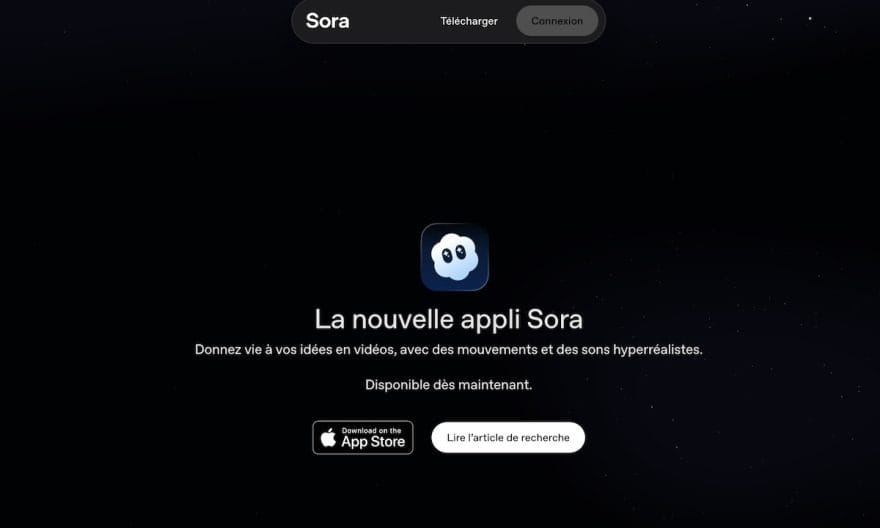
OpenAI has just taken a decisive step in the world of video generation with the launch of Sora 2, a major update that promises to redefine industry standards. This new version, unveiled on September 30, 2025, replaces its predecessor, which was beginning to show its limits against competitors like Veo 3. The California-based company compares this evolution to the transition from GPT-1 to GPT-3.5, highlighting the extent of the improvements made. With more realistic videos, better adherence to prompts, integration of sound design, and capabilities for injecting real content, Sora 2 establishes itself as a serious competitor in the emerging market of AI video generation. This technological revolution 🚀 opens new perspectives for content creators, marketers, and visual communication professionals. In this article, we will explore in detail the technical innovations of Sora 2, its enhanced understanding of the physical world, its capabilities for integrating real content, and its advanced audio features, before analyzing the impact of this technology on the creative ecosystem.
📋 Summary
The technical innovations of Sora 2
Sora 2 represents a significant technological leap compared to its previous version. OpenAI has invested heavily in improving video generation algorithms, allowing for much more precise adherence to user prompts. This improvement results in videos that better match expectations and provided descriptions, significantly reducing the number of attempts needed to achieve the desired outcome.
The underlying architecture of Sora 2 has been completely rethought to handle gigantic datasets of video content sourced from the web, third-party partnerships, and user generations. This approach enables the model to learn more effectively the nuances of video creation, from camera movements to transitions between scenes. The visual quality 🎬 is considerably enhanced, with more detailed textures and more realistic lighting.
A particularly impressive aspect concerns the temporal coherence of the generated videos. While Sora 1 could present inconsistencies between frames, Sora 2 maintains remarkable visual continuity throughout the video. This improvement is crucial for professional applications where quality and coherence are paramount.
The resolution and smoothness have also benefited from substantial improvements. The generated videos now feature higher definition and more natural movements, rivaling traditional productions. This evolution positions Sora 2 as a viable tool for demanding creative projects, paving the way for new applications in digital marketing and the AI revolution in the sector.

A revolutionary understanding of the physical world
One of the most remarkable advancements of Sora 2 lies in its understanding of the physical world. Since the launch of the first version in February 2025, the OpenAI team has focused on training the model to faithfully simulate the laws of physics. This approach allows for the generation of videos where objects behave credibly, adhering to principles of gravity, inertia, and collision.
This improvement is particularly evident in the generation of complex scenes that were previously impossible to reproduce. Olympic gymnastics routines, with their precise acrobatic movements, can now be simulated with striking realism. Backflips, somersaults, and even figure skating moves like the Axel are rendered with a precision that defies imagination 🤸♀️.
The management of failure situations also constitutes a major innovation. Unlike previous models that could generate physically impossible scenes, Sora 2 incorporates the notion of failure into its generations. A basketball player who misses their shot will see the ball bounce naturally off the backboard, rather than magically landing in the hoop. This attention to detail significantly enhances the credibility of the generated videos.
The impact of this physical understanding extends far beyond mere visual realism. It opens new possibilities for training, simulation, and education. Professionals can now use Sora 2 to create educational content showcasing complex physical phenomena, sports demonstrations, or event simulations. This capability transforms the tool into a true creative assistant for sectors requiring a faithful representation of physical reality.
Integration of real content and deepfakes
Sora 2 introduces a revolutionary feature with its ability for real content injection, dubbed “cameos.” This innovation allows users to integrate existing images or videos into their creations, opening up a realm of unprecedented creative possibilities. The model can reproduce the physical appearance of a person, object, or animal with remarkable accuracy, without requiring any specific prior training.
This capability naturally raises important questions regarding deepfakes and their ethical use. The ease with which Sora 2 can create realistic synthetic content necessitates careful consideration of the safeguards to be put in place. OpenAI has emphasized the need to use this technology responsibly, developing detection tools and watermarks to identify generated content 🔍.
From a creative standpoint, this feature opens up extraordinary perspectives for content creators. It becomes possible to integrate real characters into fantastical environments, create scenarios impossible to film under real conditions, or even digitally resurrect historical figures for educational projects. Marketing applications are also promising, allowing brands to create personalized campaigns with their ambassadors.
The reproduction accuracy achieved by Sora 2 is particularly impressive. Facial details, expressions, body movements, and even clothing specifics are faithfully reproduced. This quality of rendering paves the way for professional applications in cinema, advertising, and social media, where visual authenticity is crucial for audience engagement.
Advanced sound design and mobile application
The integration of advanced sound design capabilities is one of the most anticipated innovations of Sora 2. Like Veo 3, OpenAI’s new model can now generate synchronized sound effects and dialogues with an impressive level of realism. This feature completely transforms the user experience, moving from simple silent videos to complete audiovisual productions.
The audio-video synchronization represents a considerable technical challenge that Sora 2 meets with flying colors. Footsteps perfectly match movements, dialogues correspond to lip movements, and environmental sound effects create an immersive atmosphere. This audiovisual coherence 🎵 significantly elevates the quality of the generated productions, bringing them closer to professional standards.
Alongside the launch of Sora 2, OpenAI unveiled a revolutionary mobile application designed as a true creative social network. This platform allows users to create, share, and remix video creations from other community members. The social approach encourages creative collaboration and democratizes access to advanced video generation tools.
The iOS application offers a personalized news feed that adapts to each user’s creative preferences. This personalization fosters the discovery of new styles and techniques, creating a mutual learning ecosystem. Creators can draw inspiration from their peers’ work, experiment with different approaches, and develop their own creative style. This community dimension transforms Sora 2 from a simple technical tool into a true collaborative creative platform, foreshadowing the future of AI-assisted creation tools.
Conclusion
Sora 2 undeniably marks a major turning point in the evolution of video generation by artificial intelligence. The technical improvements, understanding of the physical world, integration of real content, and sound design capabilities position this tool as a serious competitor to existing solutions. I am particularly impressed by the quality of the generated videos and their temporal coherence, which open up real professional prospects.
However, I remain aware of the ethical challenges raised by this technology, particularly concerning deepfakes and potential misinformation. The responsibility of developers and users will be crucial to ensure a beneficial use of these tools. OpenAI’s approach, which favors a gradual and controlled deployment, seems wise to allow for a gradual market adaptation.
The future of video creation looks exciting with tools like Sora 2. I believe we are witnessing the beginnings of a creative revolution that will democratize the production of professional-quality video. Creators, marketers, and businesses now have a technological arsenal 🎯 that will enable them to realize their most ambitious visions, fundamentally transforming our relationship with audiovisual creation.
📝 In brief
- Sora 2 revolutionizes video generation with major technical improvements
- The understanding of the physical world allows for unprecedented realistic simulations
- The integration of real content opens new creative possibilities
- Advanced sound design and the mobile application democratize access to technology
- The ethical implications require responsible use of these tools