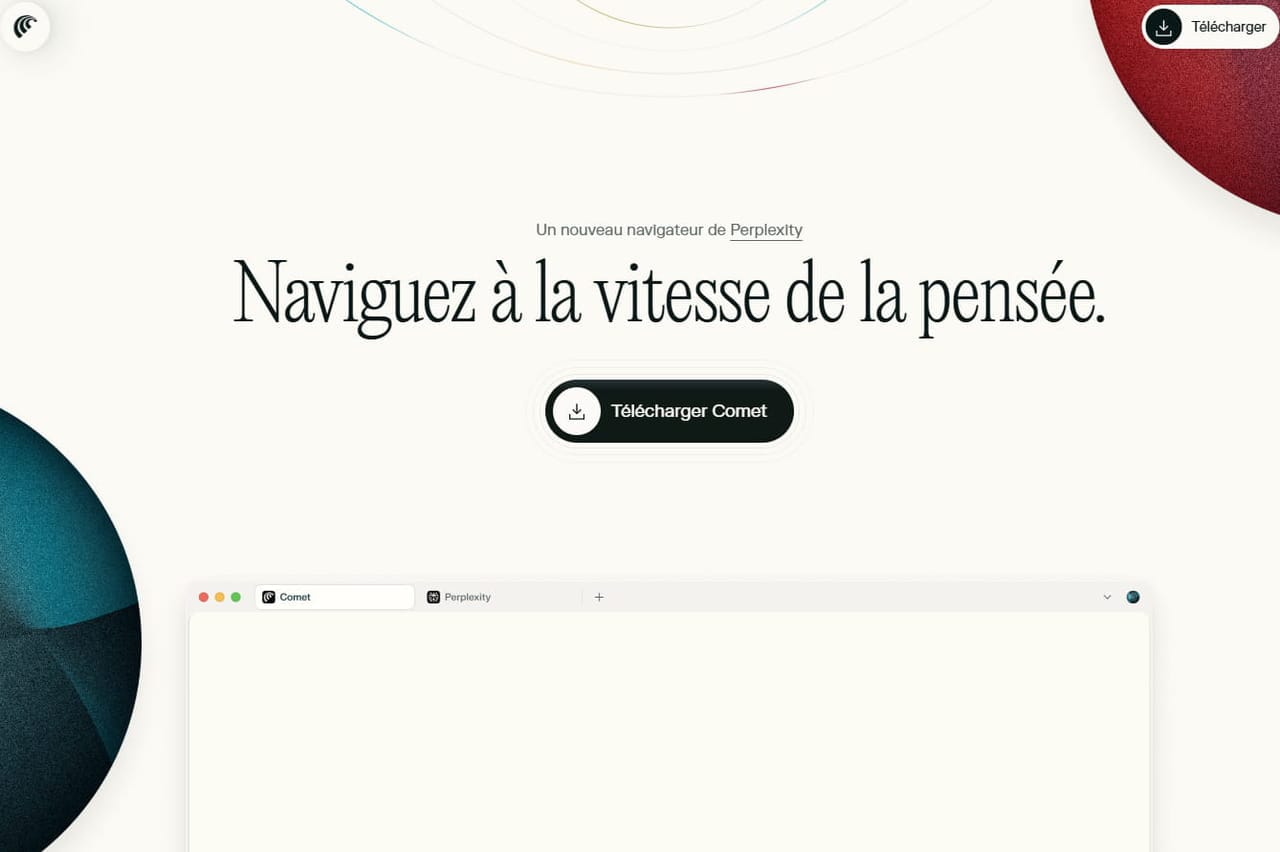
In the constantly evolving digital ecosystem, traditional web browsers are showing their limits in the face of growing needs for automation and artificial intelligence. It is in this context that Perplexity launches Comet, a revolutionary browser that natively integrates AI to transform the way we browse the web. After a month of intensive testing, I can affirm that this innovation 🚀 marks a turning point in the online user experience. Comet does not merely display web pages like its predecessors; it acts as a true intelligent assistant capable of understanding, analyzing, and executing complex tasks autonomously. This revolutionary approach fits perfectly into the current trend of AI revolutionizing marketing and digital tools. The user experience offered by Comet provides a fascinating glimpse of what web browsing will look like tomorrow, even if some limitations still persist today.
📋 Summary
[content h2]
🔍 In brief
- Comet revolutionizes browsing with its integrated AI assistant on the right column
- Complete automation of tasks: forms, social networks, calendar, and spreadsheets
- Based on Chromium with easy migration from Chrome
- Current limitations: system performance and learning curve
- Huge potential to transform the professional web experience
The integrated AI assistant: the heart of Comet’s innovation
The most distinctive element of Comet lies in its integrated AI assistant directly within the browser interface. Unlike external solutions that require extensions or separate applications, Perplexity has made the bold choice to natively integrate this artificial intelligence into a dedicated column located on the right side of the screen. This architectural approach allows for smooth and contextual interaction with the web content being viewed.
The assistant uses Perplexity’s AI models to offer advanced search capabilities that far exceed traditional engines. Rather than simply returning a list of links, the AI analyzes, synthesizes, and presents information in a structured and relevant manner. This feature proves particularly useful for marketing professionals who need to conduct in-depth research on their target markets.
Agentic browsing 🤖 represents a major evolution in human-machine interaction. The assistant can take control of the current page being viewed or open new tabs in the background to execute specific tasks. This ability for autonomous action fundamentally transforms the user experience, shifting from passive browsing to active collaboration with artificial intelligence.
The native integration with Perplexity as the default search engine ensures consistency in the user experience. However, I must note that the latency between sending a query and displaying results can sometimes reach one to two seconds, which may seem long in a context of intensive use. This technical limitation deserves consideration when evaluating the tool for daily professional use.
Advanced automation: from browsing to complex tasks
Comet’s automation capabilities represent a significant leap forward in digital productivity. The assistant can autonomously manage online spreadsheets, perform complex calculations, organize data, and even generate reports. This functionality proves particularly valuable for professionals who regularly handle data in their marketing analyses or reporting.
The automatic filling of forms is another remarkable innovation. The AI can not only complete fields with the appropriate information but also perform contextual searches to obtain missing data. For example, when booking a restaurant table, Comet can automatically search for availability, compare options, and finalize the reservation according to the user’s defined preferences.
Integration with Google services, notably Google Calendar, allows for automated management of appointments and events. The assistant can analyze the content of an email, extract relevant information (date, time, location, participants), and automatically create the corresponding event in the calendar. This feature eliminates repetitive tasks and significantly reduces the risk of human error.
However, Comet’s automation still requires human supervision for complex tasks involving multiple steps. The AI systematically demands final validation before executing critical actions, which is a cautious approach but can slow down certain processes. This limitation underscores the importance of clearly defining appropriate use cases to maximize the tool’s efficiency.

Marketing features and professional productivity
For digital marketing professionals, Comet offers particularly interesting features in terms of content creation and publication. The assistant can perform automated competitive monitoring, analyze market trends, and generate content tailored to different social platforms. This capacity for analysis and content generation fits perfectly into modern marketing automation strategies.
Automatic posting on social media 📱 represents a considerable time saver for community managers and marketing managers. Comet can adapt the format and tone of the message according to the target platform (LinkedIn, Twitter, Facebook), optimize hashtags, and even schedule posts for peak audience times. However, this feature still requires human validation before publication, thus ensuring quality control of the disseminated content.
The tool also excels in performance analysis and automated reporting. It can collect data from various sources (Google Analytics, social networks, CRM), compile them into customized dashboards, and generate detailed reports. This ability to aggregate and analyze marketing data is a major asset for companies looking to optimize their analytics strategies.
I find Comet’s ability to adapt to the user’s professional context particularly impressive. The AI gradually learns habits, preferences, and business processes to propose increasingly relevant automations. This progressive personalization transforms the tool into a true intelligent personal assistant, capable of anticipating needs and offering proactive solutions.
Current limitations and challenges to overcome
Despite its promising innovations, Comet presents several technical limitations that may hinder its widespread adoption. Performance issues are the most critical challenge: the browser can consume up to 4 GB of RAM while displaying significant slowdowns during intensive use. This excessive consumption of system resources poses particular problems for users with limited hardware configurations.
The learning curve represents another significant obstacle. Without regular and methodical use of the AI assistant and its agentic features, Comet boils down to a standard Chromium browser with Perplexity integrated. Mastering the new features requires an investment of time and training that may discourage some users, especially in a professional context where immediate productivity is a priority.
Agentic browsing, while innovative, still struggles to deliver on its promises of productivity gains. Compared to more mature solutions like ChatGPT’s agent mode, Comet’s automations sometimes lack fluidity and speed of execution. It is often quicker to perform certain tasks manually rather than wait for execution by the AI, which presents a paradox relative to the stated objectives.
Competition is rapidly intensifying in this emerging sector. Google could integrate similar features into Chrome through Gemini, while OpenAI is reportedly working on its own browser according to several industry sources. This competitive pressure forces Perplexity to accelerate development and quickly address current flaws to maintain its competitive edge. The stakes are high as the market for intelligent browsers 🌐 could quickly structure around a few dominant players.
Conclusion
After a month of intensive use, I consider that Comet represents a significant advancement in the evolution of web browsers, despite its current limitations. Perplexity’s approach, which consists of aggregating scattered features into a unified interface, constitutes an intelligent strategy that meets the growing needs for automation and artificial intelligence in our digital daily lives.
The automation features and the integrated AI assistant offer a compelling glimpse of what tomorrow’s browsers will likely look like. For marketing and communication professionals, Comet provides tools particularly suited to their specific needs, from competitive monitoring to automated content publication.
However, the current technical challenges, notably performance issues and the learning curve, still limit the widespread adoption of the tool. I recommend Comet to early adopters and professionals willing to invest time in learning new working methods, but there is still a long way to go before it becomes an industry standard.
The future of Comet will largely depend on Perplexity’s ability to quickly resolve these technical limitations while maintaining its technological lead in the face of growing competition from industry giants. The potential is undeniable, but execution will be crucial for the long-term success of this promising innovation. 🎯