The world of image generation through artificial intelligence is experiencing a fascinating evolution in October 2025. While some players consolidate their dominance, others see their influence decline surprisingly. I am particularly struck by the rise of ByteDance with its Seedream 4.0 model, which continues to outperform all its competitors for the second consecutive month. This momentum reveals important trends in the generative AI sector, where performance continues to evolve based on user feedback. The Text-to-Image Arena ranking from Artificial Analysis provides us with a clear view of these changes, based on thousands of votes from real users who anonymously compare the results of different models. This democratic approach to evaluation seems particularly relevant for understanding the true needs of creators and design professionals. The analysis of this data reveals surprises, notably the remarkable progress of Google and the unexpected decline of OpenAI, which was considered an indispensable leader just a few months ago.
📋 Summary
ByteDance Confirms Its Dominance with Seedream 4.0
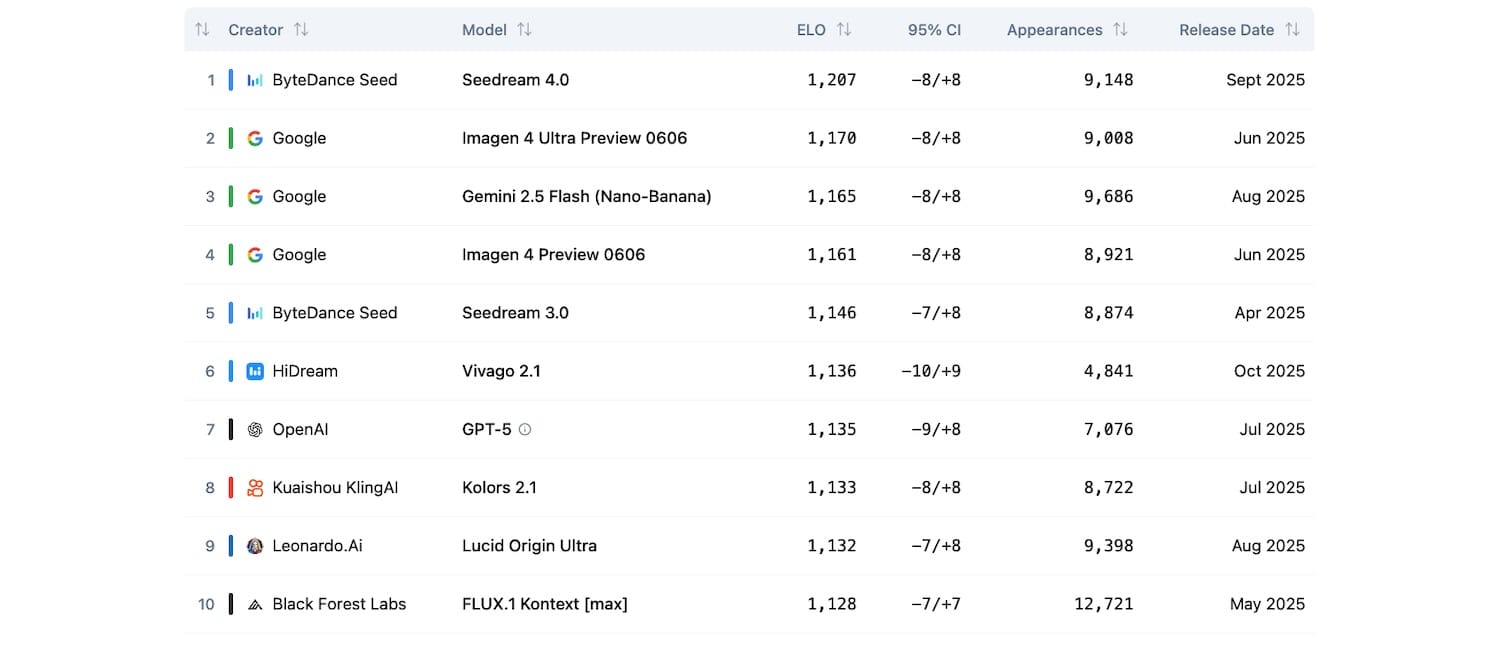
The Seedream 4.0 model from ByteDance maintains its leading position with an impressive score of 1,207 Elo points. This exceptional performance is explained by the advanced multimodal capabilities of the model, which, according to the parent company of TikTok, can “easily switch from one artistic style to another.” I find this versatility particularly remarkable in a context where creators are looking for tools that can adapt to different creative needs 🎨. The stability of this first place reflects a technological maturity that goes beyond mere sporadic innovation.
The ByteDance ecosystem also benefits from the progress of Seedream 3.0, which climbs back to the fifth position in the ranking. This dual presence in the top 5 reveals a coherent strategy of technological development. The Chinese company seems to have found the winning formula by combining advanced research with a fine understanding of user expectations. This approach reminds me of the importance of maintaining multiple versions of the same product to meet diverse needs.
ByteDance’s dominance fits into a broader trend of the rise of Asian tech companies in the field of AI. This trend questions the traditional hegemony of American and European players. I believe that this geographical diversification of innovation is beneficial for the entire ecosystem, as it stimulates competition and accelerates technological progress.

Google Catches Up with Three Models in the Top 5
The progress of Google is one of the most striking surprises in this October 2025 ranking. With Imagen 4 Ultra (2nd place), Gemini 2.5 Flash Nano-Banana (3rd place), and Imagen 4 Preview (4th place), the Mountain View giant demonstrates an impressive ability to catch up. This collective performance reflects massive investments in research and development, as well as a methodical approach to continuous improvement 🚀. I am convinced that this rise of Google will redefine market balances.
Google’s approach seems particularly smart as it focuses on diversifying models to meet different use cases. Imagen 4 Ultra positions itself at the high end with exceptional performance, while Gemini 2.5 Flash Nano-Banana prioritizes speed of execution. This segmentation strategy allows for a broad coverage of user needs, from professional creation to consumer applications.
The integration of these models into the Google Cloud ecosystem and the company’s productivity tools represents a major competitive advantage. Users can now access image generation capabilities directly from their usual tools. This approach of integrated automation seems to me to be the future of generative AI, where technology becomes invisible and naturally accessible.
OpenAI in Trouble: GPT-5 Fails to Convince
The fall of OpenAI in this ranking constitutes a real earthquake in the generative AI industry. GPT-5, with only 1,135 Elo points, finds itself relegated to seventh place, far behind the leaders. This disappointing performance is partly explained by the lack of significant evolution of OpenAI’s models in recent months. I believe the company may have prioritized other development avenues at the expense of image generation 📉. This situation illustrates how quickly positions can change in the tech sector.
The analysis of this underperformance reveals several explanatory factors. First, OpenAI seems to have focused its efforts on language models and conversational capabilities, perhaps neglecting specialization in image generation. Secondly, competition has significantly intensified with the arrival of particularly innovative new players. This situation reminds me of the importance of maintaining a balance between continuous innovation and consolidation of achievements.
However, I remain convinced that OpenAI has the resources and expertise necessary to bounce back. The company has already demonstrated its adaptability in the past, notably with the success of ChatGPT. The question will be whether it can reinvent its approach to image generation to reclaim its leading position. This situation also offers interesting opportunities for professionals looking for high-performing alternatives to traditional solutions.
The New Challengers Disrupting the Market
Beyond the tech giants, several emerging players deserve special attention. Vivago 2.1 from HiDream rises to sixth place with 1,136 Elo points, demonstrating that innovation and agility can compete with the resources of large companies. This performance particularly impresses me as it proves that the AI ecosystem remains open to new entrants 💡. HiDream’s approach seems to favor specialization and optimization rather than a race for features.
Kuaishou Kling AI with Kolors 2.1 (8th position) and Leonardo.AI with Lucid Origin Fast (9th position) complete this picture of promising challengers. These companies adopt differentiated strategies, with Leonardo.AI focusing on the needs of professional creators while Kuaishou bets on integration with its social platforms. This diversity of approaches significantly enriches the available offerings for users.
Black Forest Labs maintains its presence in the top 10 with FLUX.1 Kontext, confirming the relevance of its positioning on open-source models. This collaborative approach seems particularly interesting to me as it fosters community innovation and technological transparency. The balance between proprietary and open-source solutions contributes to a healthier and more innovative ecosystem for all players in the sector.
Methodology and Reliability of the Text-to-Image Arena Ranking
The methodology of the Text-to-Image Arena ranking is based on a particularly ingenious duel system. Each confrontation submits the same prompt to two anonymized models, allowing voters to designate the most relevant result without brand bias. This democratic approach seems to me to be more representative of real needs than traditional technical evaluations 🎯. The Elo system, borrowed from chess, ensures a fair assessment where each victory or defeat impacts the score based on the strength of the opponent.
The independent organization Artificial Analysis adds additional credibility to these results. This neutrality is essential in a sector where commercial stakes are considerable. I find it particularly relevant that the evaluation is based on feedback from real users rather than purely technical metrics. This approach better reflects the final user experience and the quality criteria that truly matter in practice.
The transparency of the methodology also allows companies to precisely identify their areas for improvement. Detailed data on prompt types, artistic styles, and evaluation criteria provide valuable insights to guide future developments. This continuous feedback loop between users and developers accelerates innovation and improves the overall quality of the solutions available on the market.
Impact on Professionals and Creators
These ranking evolutions have direct implications for design, marketing, and content creation professionals. The choice of an AI image generator becomes strategic, directly influencing the quality of productions and the efficiency of creative workflows. I recommend that professionals diversify their tools rather than limit themselves to a single solution, as each model excels in specific areas 🎨. This multi-tool approach allows for optimizing results according to projects and constraints.
The emergence of new leaders like ByteDance and the progress of Google open up new opportunities for creators. These platforms often offer competitive pricing and innovative features that can transform creative processes. However, integrating these tools into existing workflows requires a period of adaptation and training to maximize their potential.
The democratization of these technologies also transforms the skills required in creative professions. Professionals must now master the art of prompt engineering and understand the specifics of each model. This evolution reminds me of the importance of continuous training in a rapidly changing sector. Companies that invest in AI training for their teams gain a significant competitive edge.
Conclusion
The analysis of the October 2025 ranking reveals a major redistribution of power in the world of AI image generation. The dominance of ByteDance with Seedream 4.0 and the spectacular progress of Google redefine established balances, while OpenAI must rethink its strategy to reclaim its leading position. I believe that this diversification of high-performing players is beneficial for the entire ecosystem, as it stimulates innovation and offers more choices to users.
This rapid evolution of the market underscores the importance for professionals to stay informed about the latest trends and to regularly test new tools. The future of AI-assisted creation looks exciting, with increasingly powerful and accessible technologies that will fundamentally transform our creative working methods.
📝 In Brief
- ByteDance dominates with Seedream 4.0 (1,207 Elo points) for the 2nd consecutive month
- Google places 3 models in the top 5: Imagen 4 Ultra, Gemini 2.5 Flash, and Imagen 4
- OpenAI falls with GPT-5 in 7th position, revealing a lack of recent innovation
- New challengers like HiDream and Kuaishou disrupt the established market
- The Text-to-Image Arena ranking uses a reliable anonymous duel methodology