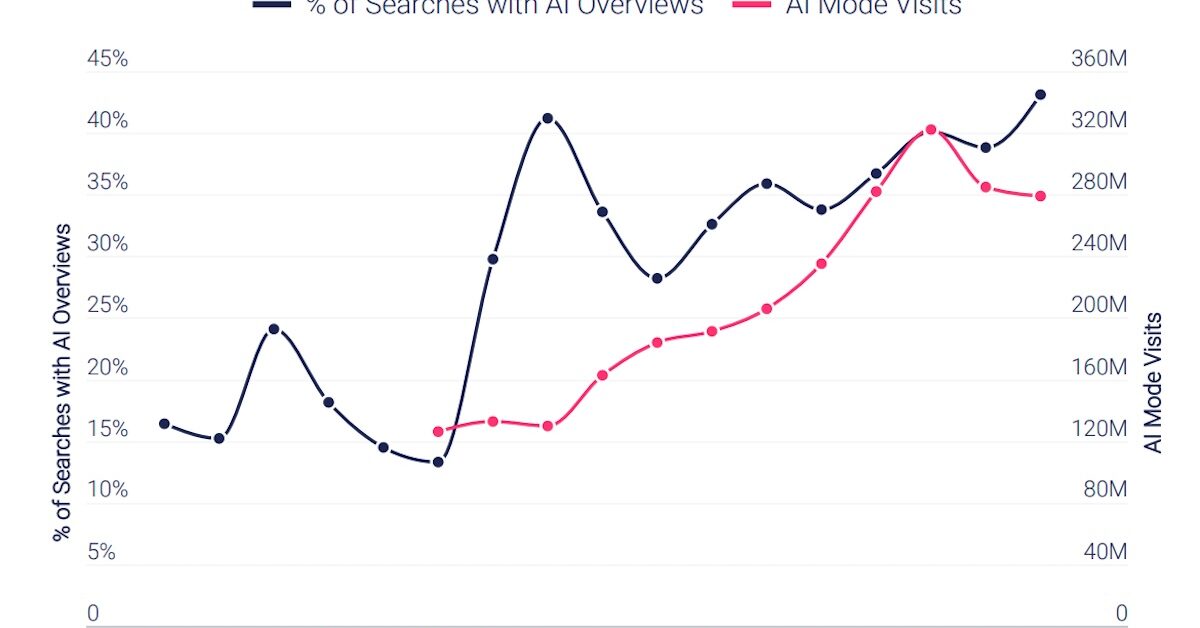
For a few years now, I have been observing a profound transformation in the way we access information online. Google, once a simple web operator directing us to other sites, is gradually becoming the final destination of our searches thanks to artificial intelligence. This evolution is not trivial: it completely redefines the digital ecosystem. A recent study by Similarweb, published in July 2026, reveals compelling figures that confirm this trend. In the United States, 43% of queries now come with an AI-generated summary, while the number of AI Mode users has exploded, rising from 126 to 279 million between June 2025 and May 2026. This is not just an additional feature: it is a paradigm shift. Users are adapting their behaviors, publishers are worried, and digital marketing strategies must reinvent themselves. In this article, I propose to dissect this transformation in detail, explore how it affects users and web professionals, and understand the major stakes that will arise from it.
📋 Summary
43% of queries now trigger AI Overviews
When I discovered the figures from Similarweb, I was struck by the speed of this adoption. Between January 2025 and May 2026, the share of queries including an AI summary jumped from 15% to 43%. This is an exponential increase that shows how much users are accepting and adopting this new form of search. Google is not just adding a layer of artificial intelligence to its traditional search engine; the Mountain View firm is orchestrating a real shift of its users towards a conversational experience. AI Overviews are no longer a simple optional feature, but a central component of the search journey.
What particularly interests me is the underlying strategy. Google uses AI Overviews as bait to attract users to a more conversational interface 🎯. Between June and August 2025, just after the deployment of the conversational interface in the American market, the share of queries including an AIO surged sharply from 13% to 40%, before slightly declining and then rising again. This pattern reveals a deliberate strategy: Google enriches traditional search with AI summaries but gradually pulls its users towards a more conversational interface. It’s a sophisticated funnel.
The number of active AI Mode users has also exploded, rising from 126 to 279 million between June 2025 and May 2026, with a particularly smooth growth curve. This steady growth suggests that the adoption of AI Mode is not a passing trend, but a structural shift. Users are gradually integrating these tools into their daily search habits, raising fundamental questions about the future of the web and publisher traffic.
The lengthening of queries: an adaptation to chatbots
What particularly interested me in the Similarweb study was the discovery that users are changing the way they formulate their queries. Historically, we had learned to translate our intentions into short and concise queries, often reduced to two or three words. But with the emergence of chatbots and language models, this habit is changing. Between May 2025 and May 2026, the share of queries longer than five words increased from 13.6% to 16.1%. Meanwhile, queries of three words or less have all slightly declined. It’s a subtle but significant transformation.
Users are now writing their queries as if they were prompts for an AI assistant 📝. They are formulating more complete, contextualized, almost conversational questions. Ethan Smith, CEO of Graphite, explains it well: “Historically, users had learned to translate their intentions into short queries. LLMs can now respond to long and complex prompts that traditional search could not satisfy.” This behavioral adaptation is fascinating because it shows how quickly users learn to leverage the capabilities of new technologies.
This change has profound implications for search engine optimization and digital marketing strategies. SEO professionals must now optimize their content not only for traditional short queries but also for long and conversational queries. Long-tail keywords are becoming even more important. Complete questions, natural formulations, content that addresses complex intentions are gaining importance. This is a major shift in how we must think about web content.
AI Mode vs ChatGPT: two approaches to conversational search
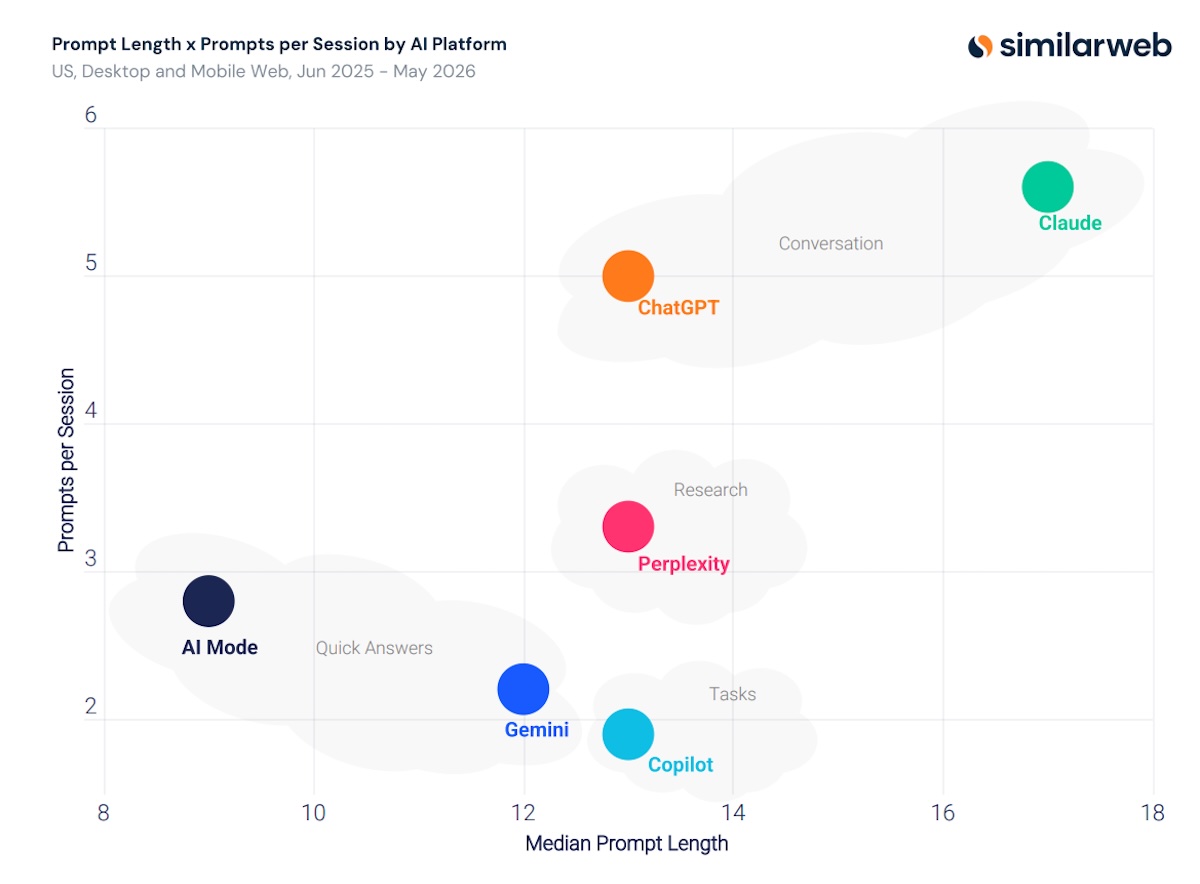
By analyzing the data from Similarweb, I noticed an interesting distinction between different AI platforms. AI Mode and Gemini are used by internet users “in a logic of quick search and response,” with “shorter and fewer prompts.” On average, users send 3 prompts per session to AI Mode, compared to 5 or more to ChatGPT and Claude. This difference reveals two distinct approaches to AI 🔄.
On one side, we have quick search tools like AI Mode, designed to provide immediate and direct answers. On the other, we have conversational assistants like ChatGPT and Claude, which encourage deeper and iterative interactions. By May 2026, 95% of ChatGPT users continue to use Google in parallel. This shows that these platforms do not directly compete but rather coexist in the digital ecosystem. Users experiment with multiple AI platforms rather than restricting themselves to a single assistant. It’s a rational diversification strategy.
What interests me is that this coexistence creates a new dynamic. Users choose the tool based on their need: a quick search on Google with AI Mode, an in-depth exploration on ChatGPT, a specific task on Claude. This fragmentation of attention and usage poses major challenges for publishers and marketers. We can no longer assume that all traffic comes from a single source. Visibility strategies must adapt to this new multi-platform reality.
Publishers facing the threat of AI Overviews
Here is the point that worries me the most as a digital professional: the omnipresence of AI-generated summaries in organic results directly threatens publishers. Since the launch of AI Overviews in the United States in May 2024, all studies have found that the presence of an AIO leads to a significant decrease in the number of clicks. In April 2025, Ahrefs reported that the CTR (Click-Through Rate) of the page in the first position of the results dropped by nearly 35% when an AIO was displayed on the screen. This is a massive reduction that directly threatens business models based on organic traffic.
The problem is that users often settle for the answer provided by the AI without continuing their exploration. Why click on a link if you already have a synthesized and immediate answer? This logic is understandable from the user’s perspective, but it creates an existential crisis for publishers 😰. News sites, blogs, educational resources that relied on organic traffic from Google are seeing their revenues collapse. And now, with the deployment of AI Overviews in France on July 22, 2026, this threat becomes immediate for French publishers.
What particularly concerns me is that this transformation is happening at a time when publishers are already weakened by years of declining advertising revenues and algorithmic changes. Content strategies must evolve rapidly. Publishers need to find new ways to create value, attract traffic, and monetize their audience. Some are exploring newsletters, others premium content, and still others partnerships with AI platforms. But there is still no miracle solution. This is a critical transitional moment for the digital publishing industry.
Conclusion
In observing this transformation, I am convinced that we are witnessing a major turning point in the history of the web. Google is not disappearing, but reinventing itself. From a web operator, it is becoming the final destination of our searches, thanks to generative AI. This evolution is inevitable and, in many ways, logical. Users gain in efficiency and immediacy. But publishers, content creators, and digital marketing professionals must adapt quickly. The visibility strategies we knew are no longer sufficient. We must rethink our approach to content, distribution, and monetization.
The future of the web will not be written by a single platform, but by a complex ecosystem where traditional search engines, conversational assistants, and new forms of access to information coexist. The digital professionals who will succeed will be those who understand this complexity and can navigate this new environment. It is a challenge, certainly, but also an opportunity for those who can innovate and adapt. AI is revolutionizing marketing and we all need to prepare for this new reality.
📝 In Brief
- 43% of Google queries now include AI-generated summaries in the United States
- Users are adapting their queries by writing them as prompts, with longer and more conversational formulations
- AI Mode, ChatGPT, and Claude coexist in the digital ecosystem, each serving different uses
- Publishers are facing a massive drop in organic traffic (up to a 35% reduction in CTR) with the arrival of AI Overviews