Since the beginning of 2026, I have noticed a major transformation in the way Google manages the visibility of websites. Last June, Google launched a new report in Search Console specifically dedicated to generative AI, and frankly, it’s a change that deserves our full attention. This report now measures how your content appears in AI-generated responses, a metric that is becoming crucial for understanding your online presence. Until now, this data was buried in overall performance reports, making it difficult to accurately analyze your visibility in AI results. With this new tool, Google finally offers transparency on impressions generated by generative AI, AI Previews, and generative features of Discover. I will explain in detail how this report works, what data it allows you to track, and most importantly, how to prepare for the imminent arrival of AI Overviews in France. This is an opportunity not to be missed to optimize your SEO strategy and remain competitive in this new search environment.
📋 Summary
Understanding the New Generative AI Report from Google Search Console
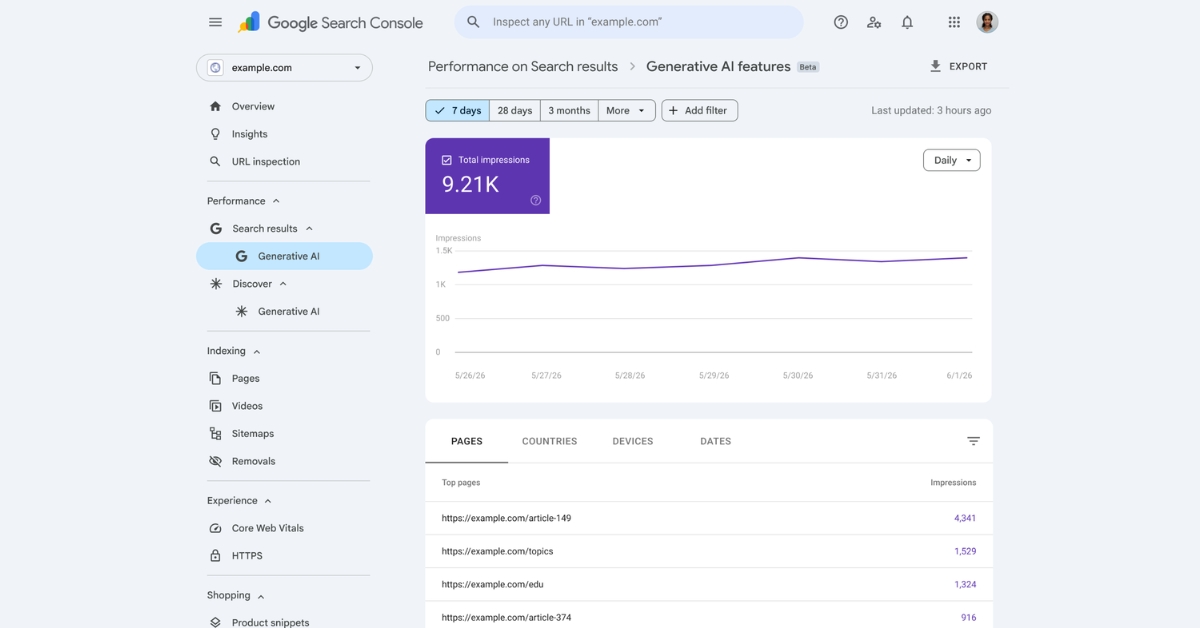
The generative AI report that Google rolled out in June 2026 represents a significant advancement in measuring online visibility. This report specifically isolates data related to AI Previews, AI Mode, and generative features of Discover, which were previously mixed with other performance metrics. I must say that this separation was really necessary for SEO professionals looking to precisely understand their impact in AI-generated results. The report measures impressions, meaning the frequency with which a URL from your site appears in a response generated by generative AI 🤖, giving you an initial indication of your relevance to Google’s AI models.
What makes this report particularly useful is its ability to break down data along four distinct axes. You can analyze the affected pages by grouping them by canonical address, allowing you to quickly identify which content is most used by AI. Next, you have the option to filter by country, which is essential if you operate in multiple geographic markets. Device data (desktop, tablet, mobile) helps you understand how your content is used according to the search context, and finally, temporal tracking (hourly, daily, weekly, monthly) allows you to detect trends and seasonal variations.
However, it is important to note a major limitation of this report: it does not tell you anything about the clicks generated by these appearances or the specific queries that triggered the display of your content. You know that your page has fed an AI summary, but you do not know if the user subsequently visited your site. This is a different approach from Bing Webmaster Tools, which has documented citations (the content used as a source by Copilot) since February rather than just impressions.

The Four Dimensions of Tracking in the AI Report
To truly leverage this new report, you need to understand how to use its four filtering dimensions. The first dimension, pages, allows you to identify your best-performing content in AI results. By analyzing this dimension, you can see which types of content Google considers relevant enough to include in its generated responses. I recommend starting with this analysis to identify your strengths and opportunities for improvement. You can group results by canonical address, which is crucial if you have page variations or URL parameters that could fragment your data.
The second dimension, countries, is particularly important if you have an international audience. This dimension shows you the geographic origin of the searches that triggered the display of your content in AI responses. It is a key element 🌍 for understanding your global presence and for adapting your content strategy according to regions. If you notice that your content appears much more often in the AI results of a specific country, this can help you refine your local SEO approach.
The third dimension concerns devices (desktop, tablet, mobile), and it helps you understand how your content is used according to the search context. Mobile and desktop users may have different needs, and this dimension allows you to see if your content performs better for one or the other. Finally, the fourth dimension, temporal tracking, allows you to track your impressions over different periods: hourly, daily, weekly, or monthly. This temporal granularity is essential for detecting trends, activity spikes, and seasonal variations that could affect your visibility in AI results.
Current Limitations and What You Need to Know
Although this new report is a major advancement, it is important to understand its current limitations. The report does not provide data on the clicks generated by AI impressions, which means you cannot directly measure the traffic that these appearances generate to your site. This is a frustrating limitation for marketing professionals looking to establish a direct link between AI visibility and conversions. However, I believe that Google will likely add this data in the future, as it is essential for understanding the true impact of AI Overviews on organic traffic.
Another important limitation is the lack of data on the specific queries that triggered the display of your content. You know that your page has been used as a source by AI, but you do not know exactly what question the user asked. This information would be extremely valuable for optimizing your content and understanding the search intents you are serving. I expect Google to gradually improve this report by adding this data, especially as AI Overviews roll out in more countries 📈.
It is also crucial to note that this report measures impressions, not clicks. An impression simply means that your content has been used as a source by generative AI, but it does not guarantee that the user clicked on your site or even saw your URL in the response. This distinction is important for calibrating your expectations and understanding that AI visibility is a different metric from traditional organic traffic. Therefore, you should combine this data with other metrics from Google Analytics to get a complete picture of your performance.
The Imminent Arrival of AI Overviews in France
One of the reasons this report is becoming so important now is that AI Overviews are soon arriving in France. According to recent information revealed by Ouest France, Google plans to deploy AI Previews and AI Mode in its French search engine before September 23, 2026. This is a key date to remember, as it marks the moment when your visibility in AI results will become a tangible reality for your French audience. I must emphasize that France would be among the last countries to benefit from this feature, which has already been active in over 120 countries for more than two years.
This late arrival in France is partly explained by the complex negotiations between Google and French press publishers. Google has committed to publishers on three fundamental points that will shape how AI Overviews will function in France 🇫🇷. First, publishers will have the option to choose whether or not to appear in AI results, giving them control over their content. Second, Google commits to providing complete transparency on the number of impressions generated by their content, which is exactly what the new generative AI report from Search Console allows to measure. Third, Google plans to compensate publishers for neighboring rights for those already covered by this regime.
These commitments are important because they reflect a recognition of the value of journalistic and editorial content in AI responses. However, it is important to note that these commitments primarily apply to press publishers. For other content creators and businesses, the approach may be different. I recommend starting now to optimize your content for AI Overviews, focusing on clarity, relevance, and the structure of your articles.
How to Optimize Your Content for AI Responses
Now that you understand how the generative AI report works and know that AI Overviews are coming to France, it’s time to think about optimization. The first step is to analyze your current data in the generative AI report from Search Console. Identify your pages that generate the most AI impressions and understand why they are considered relevant by Google. These pages are likely well-structured, comprehensive, and answer specific questions that users are asking 💡. I recommend using these pages as templates to optimize the rest of your content.
The second step is to ensure that your content is easily extractable by AI models. This means using a clear structure with headings, bullet points, tables, and well-organized paragraphs. AI models find it easier to extract and synthesize content that is well-structured. Avoid long, dense paragraphs and prefer a modular approach where each section addresses a specific aspect of the topic. Use relevant keywords naturally in your content, as AI models use these signals to understand the context and relevance of your content.
The third step is to focus on the quality and originality of your content. AI models are trained to recognize high-quality and original content. If your content is simply a copy or a paraphrase of other sources, it is less likely to be used as a source by AI. Invest in creating unique content that offers a fresh perspective, original data, or specialized expertise. This is particularly important if you operate in a competitive field where many sites cover the same topics.

Preparing Your SEO Strategy for the Era of AI Overviews
The arrival of AI Overviews in France marks a turning point in how we need to think about SEO. Traditionally, SEO has focused on ranking in organic search results, but with AI Overviews, there is now a new dimension: visibility in AI-generated responses. I believe that SEO professionals need to adapt their strategy to account for these two dimensions. This does not mean abandoning traditional SEO tactics, but rather complementing them with an approach that also optimizes your AI visibility.
An important part of this adaptation involves using data from the generative AI report to inform your content strategy. Regularly analyze this report to see how your content is being used by AI and adjust your approach accordingly. If you notice that certain types of content generate more AI impressions, focus on creating more similar content. If you notice that certain pages do not generate AI impressions despite good organic rankings, this may indicate that the content is not well-structured or does not meet the needs of AI models 📊.
I also recommend monitoring the performance of your competitors in AI results. Although Google does not directly provide this data, you can use third-party tools to track how your competitors appear in AI responses. This will help you identify gaps in your strategy and find opportunities to improve your visibility. Finally, remember that AI Overviews are still evolving, and Google will likely continue to refine how they work and how they display sources. Stay flexible and ready to adapt your strategy as these changes occur.
Conclusion
The new generative AI report from Google Search Console is an essential tool for understanding your visibility in AI-generated responses. With the imminent arrival of AI Overviews in France before September 2026, it is crucial to start analyzing this data and optimizing your content now. I am convinced that businesses that take the time to understand and optimize for AI Overviews will have a significant competitive advantage in the years to come. SEO is not disappearing; it is simply evolving to adapt to a new search environment where AI plays a central role.
By using the four tracking dimensions of the report (pages, countries, devices, dates), you can gain valuable insights into how your content is used by AI. Combine this data with a solid content strategy focused on quality, originality, and clear structure, and you will be well-positioned to succeed in this evolving search environment. Remember that AI Overviews do not replace traditional SEO; they complement it. Your goal should be to optimize for both, ensuring that your content is visible in both organic search results and AI-generated responses.
📝 In Brief
- Google has launched a new generative AI report in Search Console that measures the impressions of your content in AI-generated responses.
- The report allows filtering data across four dimensions: pages, countries, devices, and dates, providing granular visibility into your AI performance.
- AI Overviews will arrive in France before September 23, 2026, making it crucial to optimize your content now for this new search reality.
- To optimize your AI visibility, focus on a clear structure, original and quality content, and regularly use the generative AI report to refine your SEO strategy.