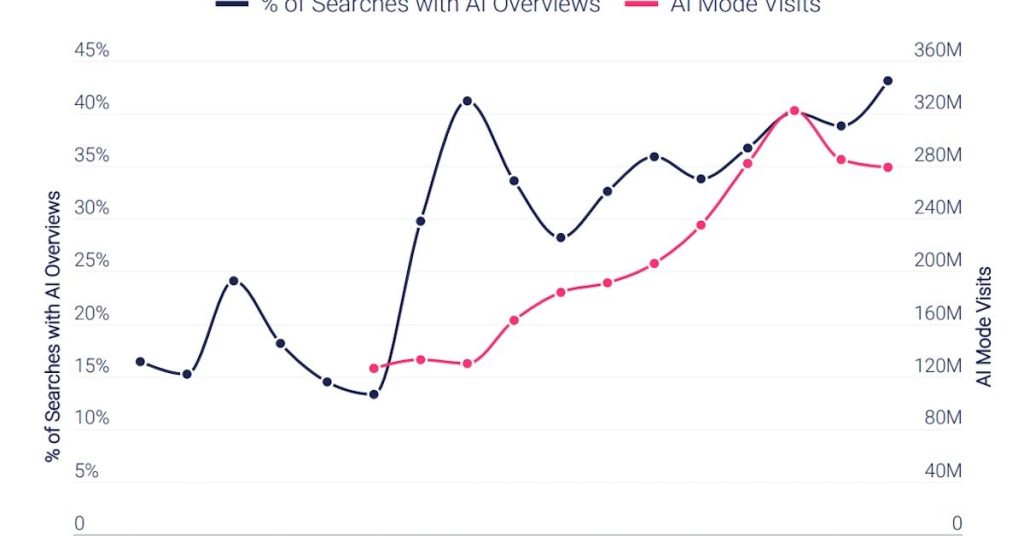
Since the arrival of AI Overviews in France in July 2026, the landscape of organic search has shifted. I must admit that I initially thought this change would be marginal, but the data we are now seeing shows a very different reality. Forty percent of keywords now display an AI-generated response, and organic clicks have dropped by an average of 30%. This is not a passing trend; it is a profound transformation in how users seek information. Search engines are no longer just lists of results: they are becoming direct responders. For marketing teams, this means one thing: the question is no longer “how many clicks am I generating from Google?” but “is my brand visible in AI responses to generate sales?”. This distinction is crucial, and it completely redefines our content strategies. In this article, I will share how to adapt your SEO approach to thrive in this new era of AI engines, based on insights from Semji, which has measured these changes across more than 500,000 keywords.
📋 Summary
Understanding the Zero Click Phenomenon in the Era of AI Overviews
The zero click is not new, but AI Overviews have dramatically accelerated it. When Google displays an AI-generated response directly at the top of the page, a significant portion of users stops there. They have their answer; they no longer click. This is a reality I have observed with many clients, and the numbers confirm it: among the 500,000 keywords tracked by Semji across more than 500 French clients in 16 different sectors, organic clicks have declined by 30% on average since the launch of AI Overview. But here’s what is important to understand: this phenomenon is not uniform. Sectors where research involves advice before purchase, such as finance 💰, health, or insurance, are much more affected. Transactional commerce, on the other hand, remains less impacted because users know they need to click to buy.
A crucial point to remember: AI Overview has accelerated the zero click, but it did not create it. Google is constantly evolving, and so is its results page. We see more ads that look like natural results, new formats, and constant algorithmic changes. Organic clicks have been dwindling for years. What is changing now is the speed and scale of the phenomenon. But the good news is that we are not starting from scratch. Our international clients have been living with AI Overview for two years, and they show us that losing clicks does not mean losing business; on the contrary.
The real question you need to ask yourself is this: how to measure performance when clicks are no longer the main metric? This is where the real challenge lies. You can be first on Google and see your traffic collapse because AI is answering in place of your site. But you can also be cited in that AI response and generate sales without seeing a single additional click. This is a complete paradigm shift.
Visibility in AI Responses: The New Holy Grail of SEO
Being cited in an AI response has become more important than being first on Google. I know this may sound exaggerated, but the data proves it. Among nearly 75,000 analyzed French contents, a page in the top three results of Google has a 75% chance of being cited in the AI Overview response. Beyond the 30th position, it’s less than 10%. This means that to be cited by AI, you must first be well-placed on Google. Nothing has changed on this fundamental point. SEO remains the foundation 🏗️ on which everything else rests.
But there is an important nuance. Not all pages are equal in the face of AI Overviews. AI responses mainly appear on content that explains: articles, guides, advisory pages. They appear very little on pages that sell: product sheets, categories, shops. This means you do not need to rewrite everything. Identify the content pages that establish your brand’s authority and work on those. A clear answer from the first lines, cited sources, and an update within the year: recent content is significantly more cited than those left abandoned.
What I recommend to my clients is to set a clear goal: to become the most visible brand in your market in AI responses, especially in AI Overviews. In 2025, 20% of companies were conducting regular actions on GEO (Generative Engine Optimization). Today, it’s 65%. By the end of the year, it will be nearly all. This is a massive transformation of marketing strategy. Moreover, we created a free Chrome extension GEO Auditor that analyzes any web page and assesses its potential to be cited by AIs.
Adapting Your Reporting and Performance Metrics
Traffic has become a vanity metric. It reassures or it worries, but it no longer indicates whether the content is working for the brand. This may be the most important conclusion I have drawn from this transformation. When you present a dashboard to your management that only shows clicks, and that dashboard displays a decline, it leads to quick and often poor decisions, such as shifting the entire budget to advertising. Instead, show the presence of your brand in AI responses and the evolution of sales. This is where true performance is read 📊.
The customer journey has changed. An internet user reads an AI response that cites your brand, forms an opinion, and three days later, when they decide to buy, they type your brand name directly. No attribution tool will link that purchase to your article. Yet, it must be accepted, and the site results must be viewed as a whole. What needs to be tracked is SEO and GEO visibility, and, on the other side, conversions and revenue, including those coming from direct traffic and the homepage.
Here’s how I recommend restructuring your reporting: first, measure your relative visibility against your competitors. On the queries that matter for your market, are you more visible than your competitors on Google, in its AI responses, in ChatGPT or Gemini? This visibility ranking should be presented to your management when traffic declines. It puts the decline in context and shows where you are gaining ground. Then, connect this visibility to business results. You can use tools like Google Analytics and Google Search Console to track the impact of AI traffic on your conversions.
Focusing Your Efforts on Strategic Content
AI responses mainly appear on content that explains: articles, guides, advisory pages. They appear very little on pages that sell. This means you need to be strategic in your resource allocation. No need to rewrite everything. Identify the content pages that establish your brand’s authority and work on those. I recommend starting with the pages that already generate significant organic traffic, then gradually expanding 🎯.
A clear answer from the first lines, cited sources, and an update within the year: these are the three key elements to be cited by AI. Recent content is significantly more cited than those left abandoned. This means you need to establish a process for regularly updating your strategic content. It is not a one-time task; it is a continuous commitment.
Here’s a practical tip: analyze AI responses for key queries in your sector. Who is cited? What types of content are used? What sources are favored? This analysis will give you a clear roadmap to optimize your own content. You will quickly see patterns: certain types of content are consistently cited, while others are never. Focus your efforts on the former.
Accelerating Your SEO Strategy to Perform in GEO
Great news: improving your SEO lays the foundation for performing in GEO. There are not two different strategies. It is the same strategy, on a broader scale. To be cited by AI, you must first be well-placed on Google. This is a non-negotiable prerequisite. This means that all the fundamentals of SEO remain valid: keyword research, on-page optimization, quality content creation, backlink building, and improving site speed 🚀.
But there are nuances. AI values clarity and structure in content more. A clear answer from the first lines, a logical structure with explicit headings, bullet lists when appropriate: all of this increases your chances of being cited. AI also values cited sources. If you mention other sources, studies, data, you increase your credibility in the eyes of the algorithm. This is what I call the citation strategy.
Here’s my advice to accelerate your SEO: start with the queries where you are already well-placed (positions 4-10). These are the easiest to improve. Optimize these pages to be cited by AI. Then, tackle the queries where you are less well-placed. Use data from AI Overviews to identify content gaps. What topics are covered by your competitors but not by you? This is where your growth opportunity lies. You can also explore web analytics tools to better understand your users’ behavior.
Preparing Your Brand for Multi-Engine Visibility
Being visible is no longer about being first on Google. It’s about being present wherever your customers ask their questions. Three years ago, 1% of French people used generative AI. Today, it’s nearly six out of ten. The search for information has splintered between Google, its AI responses, ChatGPT, Gemini, or Claude. Your strategy must reflect this reality 🌐.
Google also cites YouTube and social media a lot in its AI responses. The content of your site remains the raw material, but when adapted into video or posts on your own channels, it multiplies your chances of being cited. This means you need to think about your content in a multi-channel way. A blog post can become a YouTube video, a series of LinkedIn posts, infographics on Instagram. Each format increases your visibility surface.
The fundamental question to ask is this: on this strategic query, am I ready to let my competitors be visible in my place? If the answer is no, then you need to act now. Implement a multi-channel content strategy, optimize for AI visibility, and measure your performance holistically. This is the only way to thrive in this new environment.
Conclusion
I am convinced that we are living in a pivotal moment for digital marketing. The AI Overviews are not a threat; they are an opportunity for brands that adapt quickly. The paradigm shift is clear: we are moving from a click economy to a visibility economy. This means that your SEO strategy must evolve, but also that your performance metrics must change. Stop focusing solely on traffic. Start measuring your visibility in AI responses, your multi-engine presence, and above all, the impact on your conversions and revenue. This is where true performance lies.
The fundamentals of SEO remain valid, but they must be applied with a new perspective. Improving your SEO lays the foundation for performing in GEO. It is the same strategy, on a broader scale. Focus your efforts on strategic content, those that establish your brand’s authority. Regularly update your key pages. Be clear, structured, and cite your sources. Adapt your content across multiple channels. And above all, change your reporting before your management changes strategy. It is by showing true performance that you will convince your organization to invest in this new approach.
📝 In Brief
- AI Overviews have caused an average 30% drop in organic clicks, with 40% of keywords displaying an AI response
- Being cited in an AI response has become more important than being first on Google, but SEO remains the foundation
- Reporting must evolve: measure relative visibility against competitors and the impact on conversions, not just traffic
- Focus your efforts on strategic content that explains (articles, guides, advisory pages) rather than those that sell
- Prepare your brand for multi-engine visibility by adapting your content for YouTube, social media, and other channels