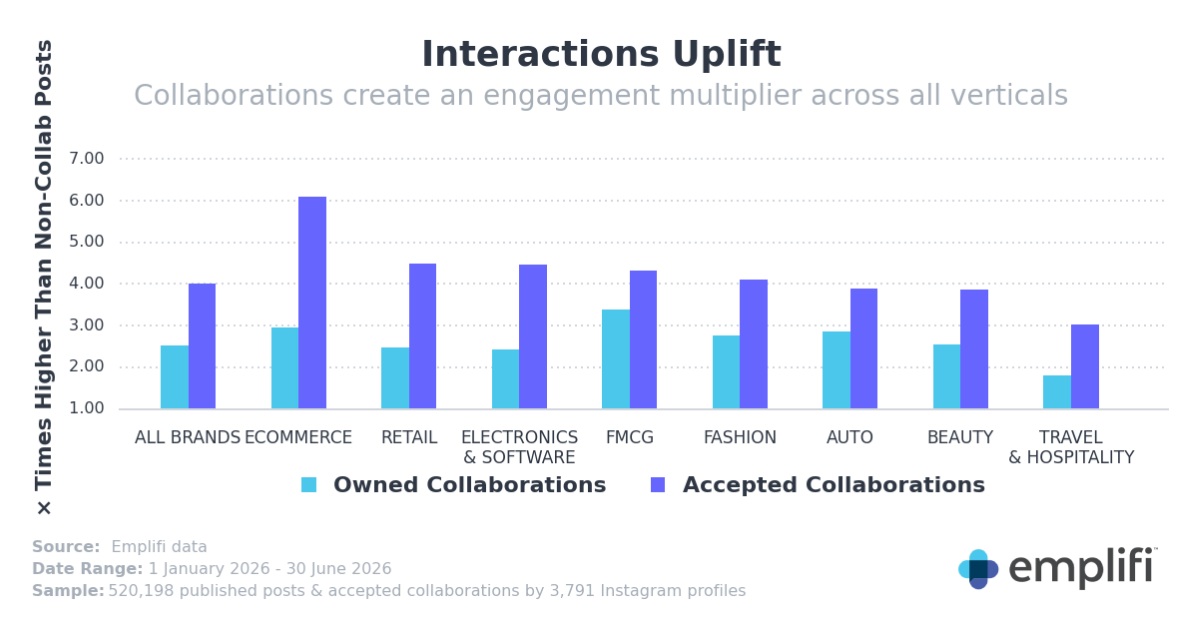
For a few years now, I’ve been observing a fascinating trend on Instagram: collaborations between brands and creators have become essential for amplifying reach. According to a recent study by Emplifi, over 73% of brand profiles publish at least one collaboration in the first half of 2026. But here’s the crucial point that many marketers overlook: not all collaboration models produce the same results. Some collaborations explode in terms of engagement, while others struggle to generate meaningful interactions. After analyzing over 520,000 posts, Emplifi researchers discovered something revealing: collaborations initiated by creators consistently outperform those led by the brands themselves. This finding applies across all sectors, from travel to fashion to electronics. In this article, I’ll share the key insights from this study to help you optimize your collaboration strategy on Instagram. You’ll learn how to choose the right model, which format to prioritize, and how to adapt your approach based on your audience size. This is an opportunity to transform your Instagram presence into a true growth engine.
📋 Summary
The Two Collaboration Models: Understanding the Differences
When we talk about collaboration on Instagram, there are two fundamentally different approaches. The first is where the brand publishes and invites a creator to co-sign the content. The second is the opposite: the creator publishes and the brand accepts the invitation. The final output is identical, a unique post that appears on all profiles that accepted. But what really changes is the account that leads the dance. I must tell you that this distinction is much more important than it seems at first glance.
The Emplifi study reveals that over 73% of monitored brand profiles use both models, but not with the same frequency across sectors. Travel and hospitality play on both fronts 🎯 with nearly 60% of profiles publishing both types of collaborations. Electronics and software brands lean more towards accepted collaborations, while the fashion sector prefers to manage its collaborations itself. However, no sector escapes the same performance hierarchy: creator-initiated collaborations consistently come out on top.
What I found particularly interesting is that this hierarchy is constant. Regardless of the sector, regardless of audience size, the model where the creator publishes first always generates more results. This is a strong signal that Instagram’s algorithms favor creator authenticity over brand control. This discovery should really change the way you think about your partnerships.

Amplification through Shares: The Real Indicator of Success
For a long time, I believed that likes and comments were the only indicators that really mattered. But the Emplifi study opened my eyes to something fundamental: shares and reposts are the true ground where collaboration makes a difference. In e-commerce and retail, accepted collaborations exceed the level of shares and reposts of non-collaborative posts by more than 5 times. That’s an impressive multiplier.
Why is this difference so important? Because a like or comment usually comes from someone who already follows your account. But a share 📤 exposes your content to accounts that don’t follow you at all. It’s pure organic amplification. All sectors measured by Emplifi show a positive gap for both models, but it’s really on this indicator that collaboration makes a difference. I would even say it’s the indicator on which you should judge a collaboration.
Now, a legitimate question arises: can we attribute this gap solely to the collaboration mode? Emplifi acknowledges that it’s more complex. An accepted collaboration is published by the creator from their account and in front of their own audience. So we are comparing two modes of distribution, not just two ways of publishing. Brands that collaborate also already have wider audiences and publish more. But even accounting for these variables, the impact of collaboration remains significant and measurable.
Winning Formats: Reels, Carousels, and Images
The format of the content plays a crucial role in the success of a collaboration. In accepted collaborations, the ranking measured by Emplifi places Reels at the top, with the highest multiplier of the entire study. Carousels come in just behind, at a close level. Single images bring up the rear, with the smallest gap between the two models. I must admit that this ranking surprised me at first, but it makes sense when you think about it.
Reels are the king format 👑 on Instagram right now, and collaborations are no exception. When a creator publishes a Reel in collaboration with a brand, it’s a winning combination. The short, dynamic, and engaging video format lends itself perfectly to co-signing. At the other end of the ranking, the carousel published by the brand records the lowest gain of the six combinations measured. The format remains interesting for detailing a product or rolling out a campaign, but it doesn’t gain much from the creator co-signing.
This finding extends that of an annual study by Metricool, which already placed Reels at the top for interactions. But here’s what’s really interesting: single images, although they come last, still maintain a positive impact in collaboration. No format is truly bad; it’s just that some formats better exploit the potential of collaboration. If you have to choose, prioritize Reels, but don’t overlook carousels for more complex collaborations.

Account Size: A Determining Factor
Here’s a discovery that should really change your strategy: the benefit of a collaboration decreases as the audience grows. Accounts with fewer than 10,000 followers multiply their interactions by 5 when they accept a collaboration published by a creator, compared to their own posts. That’s a huge gain. The ratio then decreases stepwise, down to accounts with over a million followers, where it remains positive but at the lowest level of the study.
What I found particularly revealing is that very large accounts actually publish more collaborations than others and often manage them themselves. They have understood something that smaller accounts still ignore: the partner strategy must be adapted to your size. For small accounts, less is more. For large accounts, more is better. It’s counterintuitive, but that’s what the data shows.
The number of partners works in reverse depending on the account size 🤝. The more modest profiles achieve their best results with a handful of different collaborators, and their performance declines as this list grows. Among accounts with over a million followers, the trend reverses: those who work with the largest number of distinct partners record the highest multiplier. Emplifi sees this as a way to limit overlap between the audiences reached. If you are a small brand, tighten your partner list. If you are a large brand, expand it.
This advice comes at a time when collaboration rates are rising in France. The median price of a collaboration has increased from 4,000 euros in 2025 to 5,200 euros in the first half of 2026 according to Matriochka Influences. The rates for micro-influencers have tripled over the same period. Since January 1, 2026, any commercial collaboration exceeding 1,000 euros must be subject to a written contract. Therefore, you need to be strategic in your partner choices, and this study gives you exactly the data to do so.
Optimizing Your Collaboration Strategy
After analyzing all this data, I can offer you a clear strategy to optimize your Instagram collaborations. First, reserve brand-led collaborations for messages that need to be held, such as product launches or regulated sectors. For everything else, give the creator enough leeway to keep the content within the codes of their audience. That’s where the magic really happens. Creator authenticity is your best ally, not your enemy.
Second, adjust the number of partners to the size of your account rather than the budget 💡. If you have fewer than 100,000 followers, work with 3 to 5 partners maximum per quarter. If you have over a million, you can accommodate 15 to 20. This approach will allow you to maximize the return on investment of each collaboration. Third, track shares and reposts in your creator reporting, alongside traditional interactions. That’s the indicator that really matters.
Finally, prioritize Reels for your collaborations. If you have to choose one format, this is it. Reels offer the best engagement and amplification multiplier. But don’t overlook carousels for more complex collaborations where you need to tell a longer story.
Conclusion
Instagram collaborations are not a passing trend; they are a lasting reality of digital marketing. What the Emplifi study shows us is that there is a science behind these collaborations. It’s not just a matter of luck or creativity, it’s a matter of strategy. I am convinced that brands that understand these principles and apply them systematically will have a significant competitive advantage. The data is clear: creator-initiated collaborations outperform those led by brands, Reels beat other formats, and your account size determines your optimal approach.
My final advice? Start by testing these principles with a small number of collaborations. Measure your results with a focus on shares and reposts, not just likes. Adapt your strategy based on your size and results. And above all, remember that creator authenticity is your greatest asset. Instagram audiences have become experts at detecting inauthentic content. Let creators do what they do best: create authentic content that resonates with their audiences. Your results will be multiplied.
📝 In Brief
- 73% of brands publish collaborations on Instagram, but not all models produce the same results
- Creator-initiated collaborations consistently outperform brand-led ones across all indicators
- Shares and reposts are the true indicator of success, not likes and comments
- Reels offer the best engagement multiplier, followed by carousels and single images
- Your account size determines your strategy: small accounts = few partners, large accounts = many partners
- Collaboration rates are increasing (5,200 euros median in 2026) and written contracts are mandatory beyond 1,000 euros