The world of Martech is a fascinatingly complex environment, where success relies on the ability to choose the right tools. For digital marketing professionals, the challenge is constant: how to ensure that one invests in the most effective, comprehensive platform that will generate the best return on investment? The main challenge remains online visibility and the acquisition of qualified traffic. This is precisely where the choice between two giants of SEO (Search Engine Optimization) and GEO (Generative Engine Optimization), Semrush and Ahrefs, becomes crucial. Faced with a multitude of features, complex pricing structures, and massive databases, it is easy to get lost. I find that many teams are still hesitant, unsure whether to prioritize an all-in-one approach or an ultra-specialized tool.
I have therefore decided to dive into the details of these two platforms to unravel the truth from the falsehoods. The objective of this article is not to declare an absolute “best” tool, but to provide you with a factual and updated analysis (for the year 2026) to help you choose the most relevant solution for your specific context, whether you are a freelance SEO, a small SME, or a large agency. These tools are no longer just simple keyword research software; they are complete ecosystems for the entire organic growth strategy.
🔄 [Updated in October 2026]
Semrush: The Swiss Army Knife of Digital Marketing
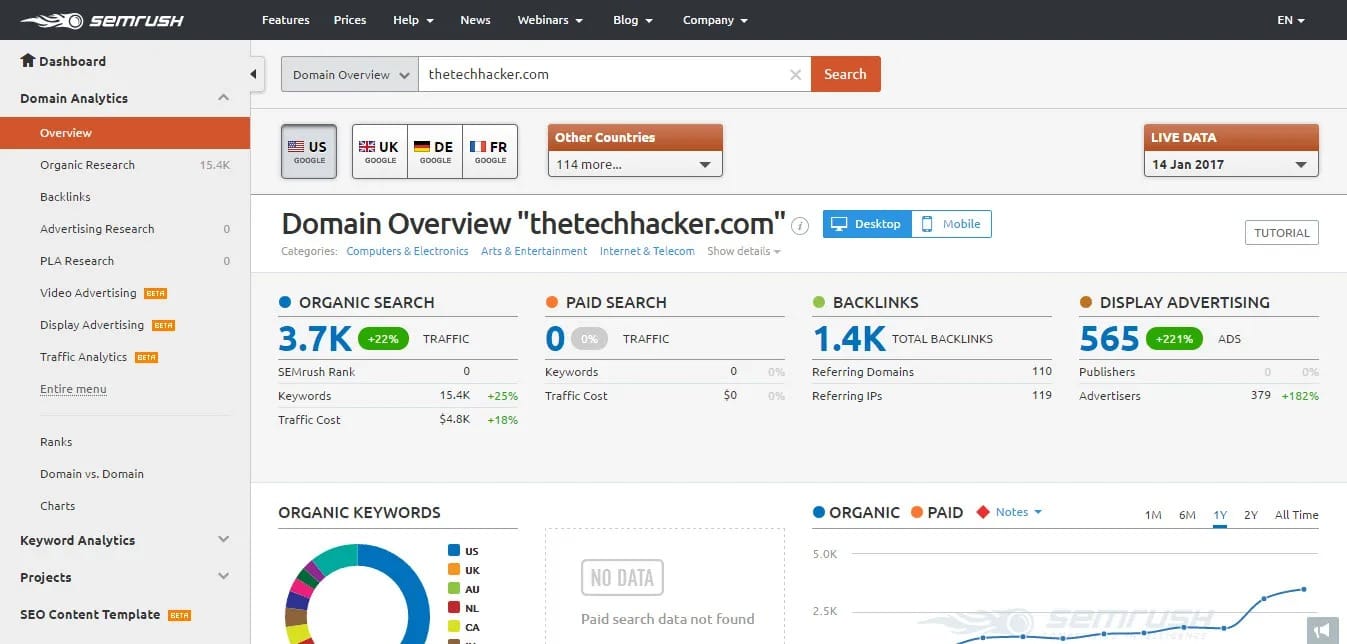
Over the years, Semrush has positioned itself as the most comprehensive marketing platform on the market. It is a true all-in-one software that goes far beyond pure SEO analysis, integrating toolkits for paid advertising (PPC), social media (SMM), and content marketing.
Strengths and Target Audience
Its greatest advantage lies in its comprehensiveness. I see it as the ideal tool for versatile marketing teams that need to centralize their efforts under one roof. If you manage both SEO, Google Ads campaigns, and editorial strategy, Semrush offers you a maximum of features. Its keyword database is reputed to be one of the largest on the market, providing very granular data on organic and paid traffic of competitors.
Weaknesses
This versatility can sometimes make the interface a bit dense or “overwhelming” for a new user. Additionally, while excellent, its backlink analysis features are sometimes considered slightly less specialized and comprehensive than those of Ahrefs, which has historically been a leader in this niche.
Ahrefs: The Essential Specialist of Netlinking
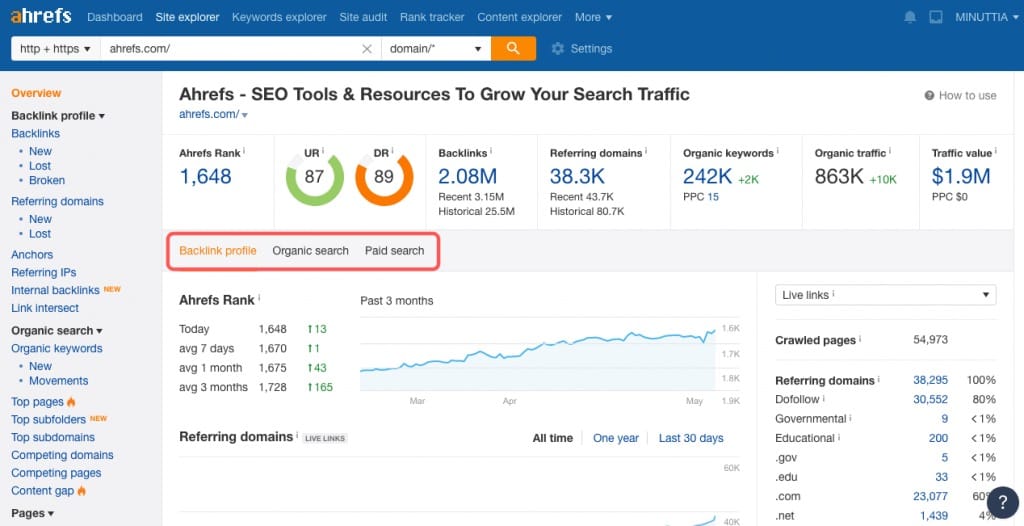
Ahrefs, on the other hand, has built its reputation on the excellence of its site explorer and link analysis. The tool is often seen as the absolute reference when it comes to understanding backlink profiles, finding netlinking opportunities, and monitoring domain authority.
Strengths and Target Audience
I recommend Ahrefs primarily to professionals whose SEO strategy is heavily focused on Netlinking. Its link database is updated extremely quickly, allowing for real-time tracking of backlink spikes. The user interface is remarkably simple and intuitive, making it very popular among users who focus almost exclusively on SEO and competitive analysis. Their exclusive metrics like Domain Rating (DR) are industry standards.
Weaknesses
The main drawback of Ahrefs is its more limited functional scope. Historically less focused on content and PPC than Semrush, it offers a more streamlined set of tools. Additionally, the lack of a true free trial (often replaced by a very limited or low-cost plan) and a “credit” system for reports can be perceived as constraints by smaller structures.
Detailed Comparative Analysis
To choose, I believe it is necessary to dissect the offering according to clear and precise criteria, ranging from raw features to user experience and pricing.
Key Features: Depth and Breadth
| Functional Domain | Semrush | Ahrefs |
| Keyword Research | Very strong. Massive database, includes PPC data and topic research. | Very strong. Excellent identification of keywords and organic traffic, but without native PPC integration. |
| Backlink Analysis | Strong. Very solid database, excellent for auditing and detecting toxic links. | Exceptional. Recognized as the best crawler, ideal for data depth, real-time tracking, and netlinking opportunities. |
| Site Technical Audit | Very strong. Very detailed and comprehensive site audit, including advanced on-page checks. | Very strong. Excellent audit features, particularly on link structure and indexing issues. |
| Content Marketing | Leader. Dedicated tools: SEO Writing Assistant, Content Audit, Topic Research. | Strong. Recent content tools (Content Gap, Content Explorer) but less integrated and detailed than Semrush. |
| PPC and Media | Unique. Complete toolkit for analyzing paid ads and display. | Absent. The tool focuses on organic traffic. |
Semrush, with its 40+ tools, maintains the advantage of breadth, particularly by integrating PPC. Ahrefs, on the other hand, reigns over the depth of analysis of incoming links and site structure.
Ease of Use and User Experience (UX)
The user experience is a major friction point. Semrush, due to its immense functional complexity, can seem “slightly overwhelming” at first glance. However, professionals who have used it for a long time appreciate its ability to generate comprehensive and customized reports, even if the overall interface is less streamlined.
Ahrefs scores higher for its ease of use. Its interface is often described as more intuitive and quicker to access, allowing users to find key information, particularly on backlinks, in the blink of an eye. For a specialist focusing on a specific task, Ahrefs’ fluidity is an undeniable asset.
Pricing and Plans
Pricing is often the decisive point. Public prices (monthly payment) are comparable, but the included features vary greatly.
| Plan (Monthly) | Semrush | Ahrefs |
| Entry Level | Pro: $139.95/month | Lite: $99/month |
| Mid Range | Guru: $249.95/month | Standard: $249/month |
| Advanced | Business: $499.95/month | Advanced: $449/month |
Note: Prices are based on public rates in US dollars (or equivalents in euros) and are subject to change. Annual plans offer a discount of about 17%.
The main pitfall lies in the limits. Semrush is slightly more expensive at the entry level (Pro), but it includes a greater variety of tools. Ahrefs offers plans whose use is limited by a credit system, which can frustrate intensive users. Semrush, on the other hand, is more transparent but charges heavily for additional users ($45/month for Pro).
For SEO agencies or large companies, access to historical data is generally included from the Guru plan at Semrush, while the limits on reports and users at Ahrefs may require moving more quickly to the Advanced or Enterprise plans.
Available Integrations
Semrush, as an all-in-one platform, offers better integration with the martech ecosystem:
- Semrush: Native integrations with Google Analytics (GA4), Google Search Console (GSC), Trello, Zapier, and content marketing tools. Its API is robust and very granular for custom reports.
- Ahrefs: Integrations are more focused on pure data (GSC, API). While it is catching up, its ecosystem of third-party tools is less developed than Semrush’s, as the focus is on the power of its own crawler and index.
Quality of Customer Support and Resources
I have found that both tools have excellent documentation (blogs, academies). However, customer feedback indicates that Semrush’s support is often perceived as more responsive and accessible, with the availability of customer service in French and sometimes by phone (depending on the plan). Ahrefs offers excellent support via email or chat, but without the same responsiveness for urgent or specific needs.
Compliance and GDPR
In the European context, data management is crucial. Although both companies are American, they comply with GDPR standards. Their data concerns public information and does not process sensitive personal data in the strict sense. Nevertheless, for large companies, I note that Semrush sometimes offers more flexibility in terms of hosting or specific contractual clauses (Business/Enterprise plans), which can reassure DPOs.
AI Features (Artificial Intelligence)
The integration of AI is the big battle of 2026.
- Semrush has a head start with the SEO Writing Assistant that uses AI to optimize content in real-time, assess keywords and search intent. The tool can also suggest improvements based on predictive analysis.
- Ahrefs has recently introduced AI features, including an AI Content Helper and the ability to track the impact of Google’s “AI Overviews.” Their AI integration is more focused on competitive analysis and optimizing content structures, but it remains less central than Semrush for content generation and immediate on-page optimization.
How to Choose the Best Solution Between Semrush and Ahrefs?
<!– wp:rank-math/howto-block {"description":"Choosing between these two platforms is a process that should be structured around your goals and resources. I propose a simple four-step approach to guide you towards the most suitable solution for your context.","steps":[{"id":"howto-step-1763145834086","title":"Step 1: Define the Strategic Priority (The Key Feature)","content":"Determine which pillar of SEO is currently most critical for your business.u003cbru003eu003cstrongu003ePriority No. 1: Deep Backlink Analysis and Netlinking?u003c/strongu003eu003cbru003eu003cstrongu003eAction: Prioritize the tool offering the largest link database, the fastest updates, and reliable domain metrics (DR, URL Rating).u003cbru003eu003cstrongu003eRecommendation: Ahrefs.u003cbru003eu003cbru003eu003cstrongu003ePriority No. 2: Content Strategy, Keywords, and PPC?u003c/strong>u003cbru003eu003cstrongu003eAction: Choose the tool that centralizes keyword research, content auditing, on-page optimization (with AI), and paid ad analysis.u003cbru003eu003cstrongu003eRecommendation: Semrush.”,”visible”:true},{“id”:”howto-step-1763146505757″,”title”:”Step 2: Assess the User Profile and Team”,”content”:”Consider who will use the tool and in what work context.u003cbru003eu003cstrongu003eAre you a solo professional or a small team focused on pure SEO?u003cbru003eThe intuitive interface of Ahrefs and its starter plans (Lite) may be sufficient for your basic research and competitive analysis needs.u003cbru003eu003cbru003eu003cstrongu003eAre you a versatile marketing team managing multiple channels (SEO, Content, Social Media, Ads)?u003cbru003eThe versatility and integration of different tools in the Semrush ecosystem (Guru or Business plan) will allow you to centralize efforts and save time.”,”visible”:true},{“id”:”howto-step-1763146552595″,”title”:”Step 3: Analyze the Budget and Usage Constraints”,”content”:”Cost is not just the displayed price, but also the cost of constrained usage.u003cbru003eu003cstrongu003eTolerance for query limits: If your usage is intensive and requires many daily reports or analyses of multiple sites (Agency), be wary of Ahrefs’ credit system.u003cbru003eu003cbru003eu003cstrongu003eNeed for multi-user licenses: If you need to add collaborators, check the additional costs. Semrush charges for additional users but offers more flexible Business plans in volume.u003cbru003eu003cstrongu003eTrial: Use the free trial period or the freemium version of Semrush to test the features before committing.”,”visible”:true},{“id”:”howto-step-1763146607219″,”title”:”Step 4: Test the Quality of Data in Your Market”,”content”:”The database is crucial, especially in niche markets.u003cbru003eu003cstrongu003eVerification: Conduct a keyword search specific to your sector (your biggest niche keyword) and compare the richness of results, estimated search volume, and difficulty level (KD/KF) provided by both tools.u003cbru003eu003br>Observation: If the data on your local or French-speaking market is deeper and more recent on one of the platforms, that one deserves your investment. Generally, Semrush is often perceived as richer in keyword and traffic data.”,”visible”:true}]} –>Step 1: Define the Strategic Priority (The Key Feature)
Priority No. 1: Deep Backlink Analysis and Netlinking?
Action: Prioritize the tool offering the largest link database, the fastest updates, and reliable domain metrics (DR, URL Rating).
Recommendation: Ahrefs.
Priority No. 2: Content Strategy, Keywords, and PPC?
Action: Choose the tool that centralizes keyword research, content auditing, on-page optimization (with AI), and paid ad analysis.
Recommendation: Semrush.
Step 2: Assess the User Profile and Team
Are you a solo professional or a small team focused on pure SEO?
The intuitive interface of Ahrefs and its starter plans (Lite) may be sufficient for your basic research and competitive analysis needs.
Are you a versatile marketing team managing multiple channels (SEO, Content, Social Media, Ads)?
The versatility and integration of different tools in the Semrush ecosystem (Guru or Business plan) will allow you to centralize efforts and save time.
Step 3: Analyze the Budget and Usage Constraints
Tolerance for query limits: If your usage is intensive and requires many daily reports or analyses of multiple sites (Agency), be wary of Ahrefs’ credit system.
Need for multi-user licenses: If you need to add collaborators, check the additional costs. Semrush charges for additional users but offers more flexible Business plans in volume.
Trial: Use the free trial period or the freemium version of Semrush to test the features before committing.
Step 4: Test the Quality of Data in Your Market
Verification: Conduct a keyword search specific to your sector (your biggest niche keyword) and compare the richness of results, estimated search volume, and difficulty level (KD/KF) provided by both tools.
Observation: If the data on your local or French-speaking market is deeper and more recent on one of the platforms, that one deserves your investment. Generally, Semrush is often perceived as richer in keyword and traffic data.
Synthetic Comparative Table
| Criterion | Semrush | Ahrefs |
| Key Features | All-in-one (SEO, PPC, SMM, Content) | Specialized (SEO and Netlinking) |
| Ease of Use and UX | Dense but comprehensive interface, highly customizable reports | Intuitive and clear interface, quick onboarding |
| Pricing and Plans | Higher entry prices, more transparent, fewer “credit” limits | Lower entry price (Lite), but usage subject to strict credit limits |
| Available Integrations | Very good (GA4, GSC, Third-party, granular API) | Good (GSC, high-performance API) |
| Quality of Customer Support | Very good, better accessibility and support in French available | Very good, comprehensive documentation, effective support via chat/email |
| GDPR Compliance | Compliant, more flexibility for Enterprise | Compliant |
| AI Features | Advanced (Writing Assistant, predictive optimization) | Emerging (Content Helper, tracking AI Overviews) |
| Major Strength | Richness of data Keywords and PPC | Depth of analysis of Backlinks |
Conclusion
The duel between Semrush and Ahrefs is a high-level match between two excellent solutions. It is difficult to make a wrong choice, but the right choice depends on your priorities.
Here is my final recommendation, based on typical user profiles:
| User Profile | Recommendation | Justification |
| Freelancer / SME with a tight budget | Ahrefs (Lite Plan) | Cheaper at entry level for quality Backlink analysis and keyword research. Its simpler interface is a time saver. |
| Versatile Marketing Team (Growing SME) | Semrush (Guru Plan) | All-in-one solution covering SEO, content, PPC. Ideal for centralizing marketing actions and benefiting from advanced AI features. |
| Large Agencies / Enterprises (Intensive Use) | Semrush (Business Plan) | Larger database, richer content tools, better management of additional users, and advertising analysis is a key differentiating factor. |
| Netlinking Specialists | Ahrefs (Standard/Advanced Plan) | Its backlink database is the most responsive and comprehensive. It is the reference tool for link analysis and tracking referring domains. |
If your absolute priority is a comprehensive marketing approach, integrating content and paid media in addition to SEO, Semrush is the most relevant and versatile choice. If, on the contrary, your strategy primarily relies on the strength of your link profile and you prioritize the simplicity of an interface very focused on pure SEO analysis, then Ahrefs will be your best ally.
To make an informed final decision, I strongly encourage you to take advantage of the trials or limited versions that both platforms offer. Nothing replaces the personal experience of the data that the tool will provide for your own site.