Since its creation in Paris in 2023, Mistral AI has established itself as the European champion of artificial intelligence, directly competing with American giants OpenAI, Anthropic, and Google. I must admit that I have closely followed the evolution of this French startup, and what impresses me the most is their unique positioning: predominantly open-source models, data hosting in Europe, and a clear sovereignty argument that resonates particularly with European companies concerned about their data. Founded by Arthur Mensch, Guillaume Lample, and Timothée Lacroix, Mistral AI has built a complete ecosystem in less than three years that deserves serious attention. This article offers you a detailed overview of the current state of this ecosystem, from the available tools to the specialized models, including the innovative features of Vibe, their flagship AI assistant. Whether you are a developer, entrepreneur, or simply curious about European alternatives to ChatGPT, you will find here the essential information to understand and fully leverage the power of Mistral AI.
📋 Summary
The Different Tools Offered by Mistral AI
Mistral AI organizes its offerings around several main products that cater to distinct profiles. I believe this multi-product approach is particularly smart as it allows everyone to find the tool suited to their specific needs. Vibe, formerly known as Le Chat, is the flagship product of the ecosystem 🎯. Accessible from the browser and iOS and Android apps, Vibe comes in three distinct modes: Chat for classic conversation, Work for executing end-to-end productivity tasks, and Code for development. It truly is a 3-in-1 assistant that covers a wide range of uses.
Beyond Vibe, Mistral AI also offers Vibe for code, a development agent available in a terminal interface, extensions for popular IDEs (VS Code, JetBrains, Zed), and background agents. This tool reads project files, modifies code, runs commands, and opens pull requests under supervision. It is particularly useful for developers looking to automate certain repetitive tasks.
Studio is Mistral AI’s platform for AI agents, allowing the design, deployment, and management of agents and AI applications. For companies wanting to go further, Forge offers the ability to train and evaluate custom AI models on their own data. Added to these products is Mistral Compute, a large-scale computing infrastructure that runs Mistral’s models and is open to labs and companies.
Which Models to Use According to Tasks
Beyond the various tools, Mistral AI also offers different models that adapt to the complexity of the task at hand. I sincerely believe that this diversity of models is a major asset for users 🔧. The majority of these models are published as open source, meaning you can download and deploy them freely. We distinguish between generalist models and specialized models, each having its own strengths.
Among the generalist models, Mistral Medium 3.5 represents the optimal balance between capability and cost. Designed for long tasks and agentic code, it is the reference model for most uses. Mistral Small 4, released in March 2026, unifies reasoning, vision, and code into a single architecture. Mistral Large 3 is the flagship model with a “mixture of experts” architecture of 675 billion parameters and a context window of 256,000 tokens.
For those working with resource-limited devices, Ministral 3 offers a family available in 3B, 8B, and 14B versions, targeting smartphones and embedded hardware. Multimodal and multilingual, this range retains impressive capabilities even on lightweight devices. Most of these models are published as open source under the Apache 2.0 license, making them freely downloadable and deployable.
Specialized Models for Specific Use Cases
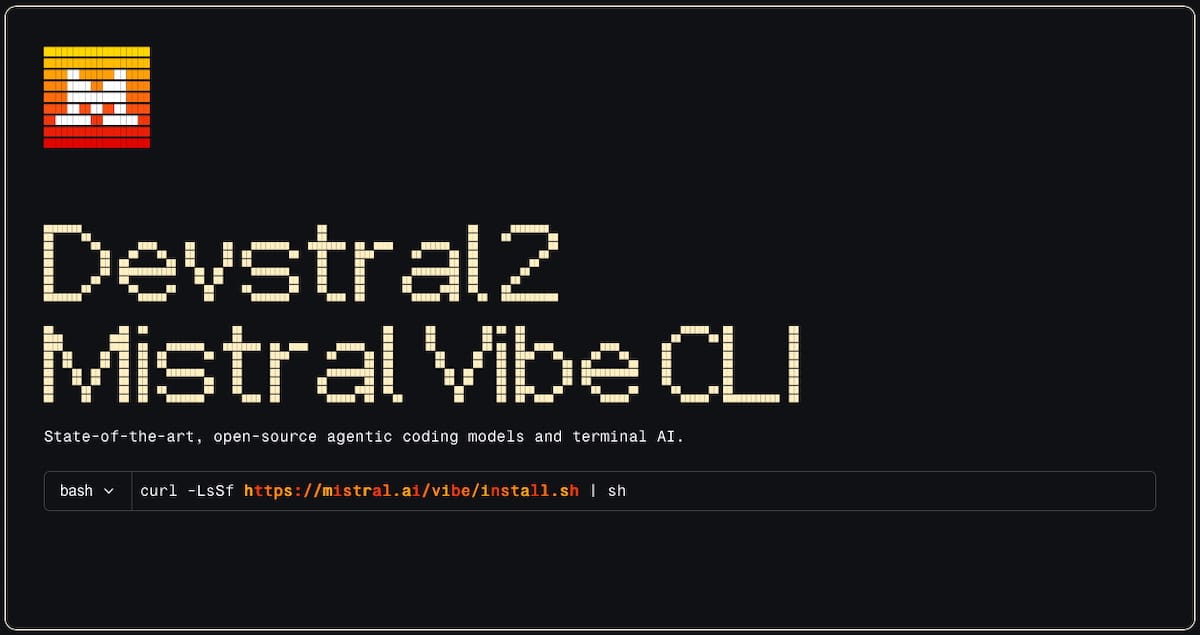
Mistral AI has developed a series of specialized models to meet very specific needs 💡. Codestral and Devstral 2 are dedicated to code: Codestral handles rapid code completion, while Devstral 2 is tailored for autonomous development agents. I must acknowledge that these tools are particularly impressive for developers looking to automate their workflow.
Voxtral is the audio range of Mistral AI, supporting transcription and voice recognition, as well as text-to-speech synthesis and voice cloning with Voxtral TTS. It powers the voice mode of Vibe, offering a truly natural user experience. Mistral OCR ensures the extraction and understanding of documents, accurately rendering the content of complex files.
Shieldstral, unveiled in August 2026, is a security classifier that analyzes texts and images based on rules written in natural language. This tool is essential for filtering problematic content and maintaining application security. Most of these models are published as open source, making them freely downloadable and deployable.
The Innovative Features of Vibe
Vibe includes a series of features that remarkably extend and customize its capabilities. I am particularly impressed by Flash Answers, which generates responses at very high speed, up to about 1,000 words per second 🚀. Vibe relies on updated web resources and AFP news, of which Mistral leverages the entire archive since 1983. It is an exceptionally rich source of information that ensures the relevance of responses.
Vibe’s skills allow you to create competencies that you add to the agent to teach it to perform a specific task. Vibe automatically activates the right skill according to the request, making the tool extremely flexible. Scheduled tasks allow for programming recurring actions or those triggered by an event, to automate monitoring or follow-up.
The Canvas is a space for drafting deliverables directly within the interface, such as reports or presentations, editable and then exportable to Notion or SharePoint. The deep search compiles and synthesizes web sources to produce a detailed response. Vibe also creates visuals from a simple description and allows for editing the generated images 🎨. Through the Memories function, Vibe retains details from past conversations to provide more relevant responses. Connectors link Vibe to external business tools, supporting the MCP protocol, and document analysis allows Vibe to process PDF files and images using OCR capabilities.
Integration with the Modern Digital Ecosystem
What makes Mistral AI particularly attractive is its ability to integrate into the modern digital ecosystem 🔗. Unlike some competitors that remain isolated, Mistral AI has understood the importance of connectivity. MCP connectors allow for seamless integration with your existing business tools. I believe this open approach is crucial for companies that have already invested in specific solutions.
Mistral AI’s open-source approach also means that you are not locked into a proprietary ecosystem. You can download the models, deploy them on your own servers, and even modify them according to your needs. This is particularly important for companies that have strict requirements regarding data sovereignty and regulatory compliance. Hosting in Europe ensures that your data remains on the continent, which is a major advantage for organizations subject to GDPR.
Conclusion
Mistral AI represents much more than just an alternative to ChatGPT. It is a coherent European vision of what artificial intelligence should be: powerful, accessible, open source, and respectful of data sovereignty. I am convinced that this approach will resonate more and more with companies and developers looking for responsible and independent solutions. The ecosystem that Mistral AI has built in three years is impressive, with tools for all profiles, models suited to every use case, and innovative features that truly make a difference.
The evolution of Mistral AI continues at a rapid pace, with new tools, models, and features announced regularly. If you haven’t explored Mistral AI yet, I highly encourage you to do so. Whether it’s to develop AI applications, automate your business processes, or simply explore the capabilities of generative AI, Mistral AI offers a robust and innovative platform that deserves your attention.
📝 In Brief
- Mistral AI is the European champion of AI with open-source models and data hosting in Europe
- The ecosystem includes Vibe (3-in-1 assistant), Studio (agent platform), Forge (custom models), and Mistral Compute (infrastructure)
- Generalist and specialized models cover all use cases, from code to voice to OCR
- Vibe offers innovative features like Flash Answers, skills, Canvas, and MCP integration
- The open-source approach and European hosting ensure data sovereignty and GDPR compliance