Is your site ready to talk? If your content cannot directly answer a question, it risks being ignored by the next wave of traffic. For decades, the Internet model has relied on the keyword. When a user wanted information, they typed a term and were directed to a list of links, forcing them to click, browse, and synthesize the answer themselves. This paradigm is now obsolete.
The advent of advanced language models (LLM) has set new expectations: users want immediate and contextual answers. At the same time, a new class of visitors, AI agents 🤖 (like ChatGPT, Claude, or future personal assistants), requires a structured method to query websites. To be relevant in this emerging “Agentic Web,” your site must no longer be a mere collection of documents, but a dialogue partner.
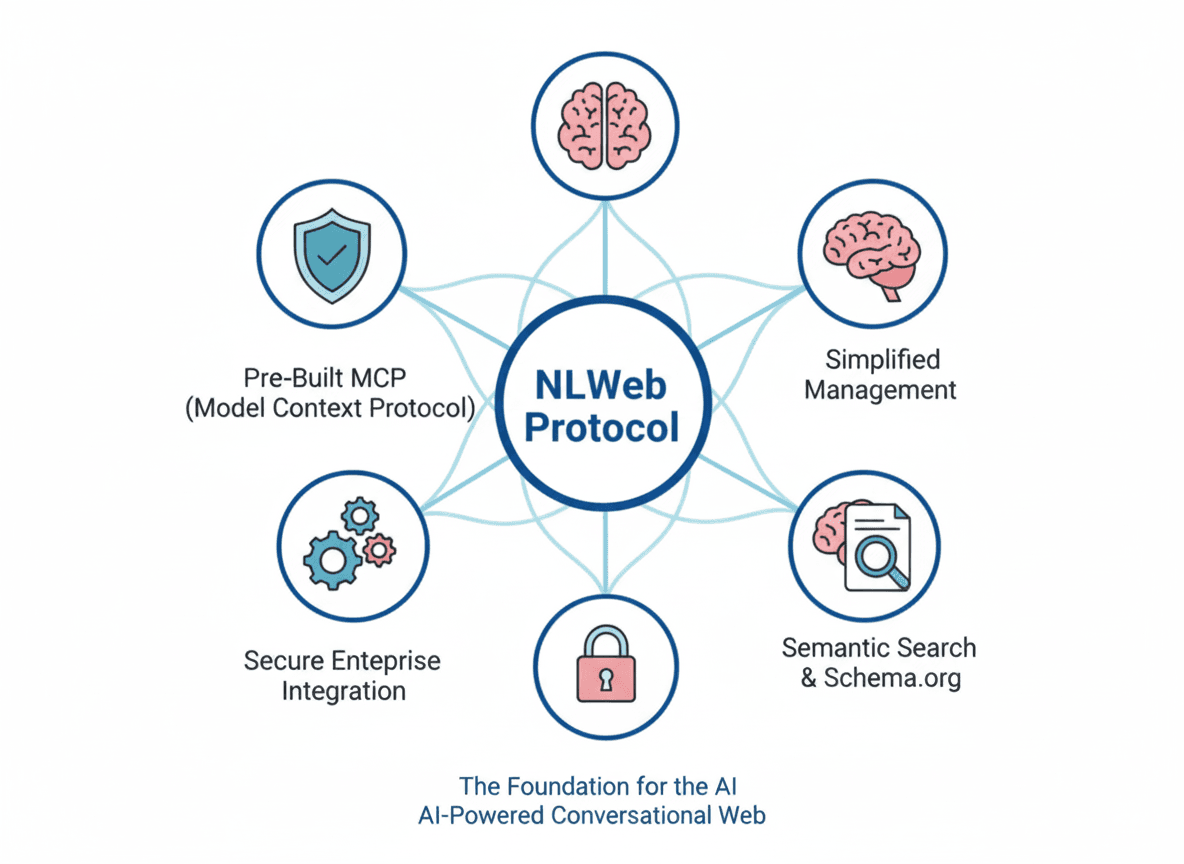
This is where Microsoft’s open protocol NLWeb (Natural Language Web) comes into play. By standardizing conversational communication, it provides a roadmap for this transformation. Here, I present the three main pathways, ranging from the simplicity of the plugin to the complexity of Cloud infrastructure, to make your site “AI-Ready.”
The WordPress Native Alternative: The WPNLWeb Plugin ⚙️
This is the most accessible entry point for millions of sites built on WordPress, looking to modernize their interface without leaving their familiar environment.
Concept and Implementation
The WPNLWeb plugin (available on the GitHub repository) installs like any other component of your CMS. It transforms your installation into a local NLWeb API server (Model Context Protocol or MCP), using your server’s resources for processing.
- Integrated Content Extraction: It relies on the WordPress database for extracting and analyzing your content. With filters and hooks (such as
wpnlweb_searchable_post_types), developers can easily extend its search capability to Custom Post Types (CPT), e-commerce products, or specific recipes. - Simple Interface: Adding a simple shortcode (
[wpnlweb]) inserts the conversational search bar into any page or post, providing immediate UX. - Semantic Structuring: One of its major strengths for SEO is formatting responses in JSON-LD compliant with Schema.org. This structuring helps not only the AI agent but also traditional search engines understand the context and relationships between your data.
Detailed Benefits
- Low Barrier to Entry: No knowledge of Python, Cloud Workers, or vector databases is required.
- Operating Cost: Aside from potential increased load on your host, the plugin is open source and incurs no external API fees (unless you connect it yourself to an external LLM).
- Code Reliability: The plugin shows high test coverage, notably at 100% on the API and security, which is reassuring for a new project.
Disadvantages and Warnings
- Plugin under development: after downloading and following the instructions, I realized that the plugin was still not operational. I contacted the person in charge, and I will keep you updated.
- Hosting Dependency: The plugin will never be faster than your host. For sites with massive databases or intense traffic spikes, natural language queries could lead to long response times.
- Keyword Search: The engine primarily relies on MySQL/WordPress search, which is inherently less precise than vector-based semantic search.
The Integrated Cloud Solution: Cloudflare AutoRAG/NLWeb 🚀
This approach is the benchmark for content publishers and large enterprises that place speed and resilience at the center of their web strategy.
Concept and Implementation
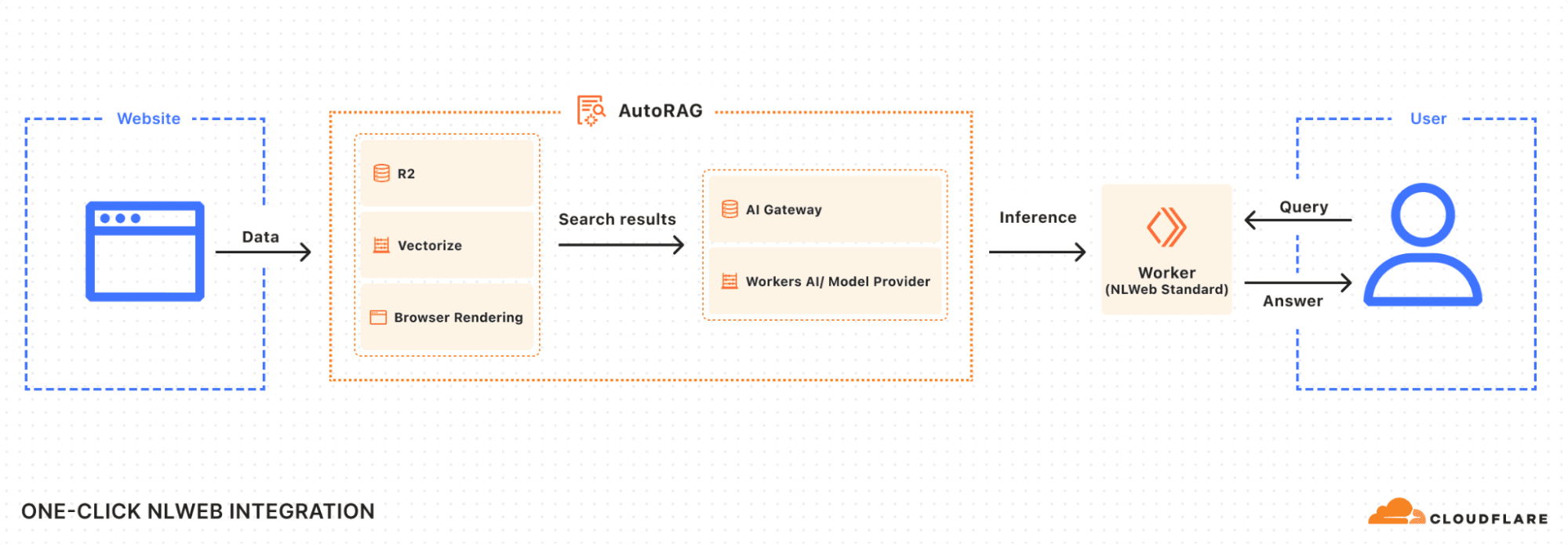
Cloudflare offers a managed SaaS service that outsources the entire AI processing pipeline.
- The Managed RAG Pipeline: The AutoRAG service handles continuous crawling of your site. It transforms content into embeddings (vector representations) and stores it in Vectorize, their ultra-high-performance vector database.
- Edge Response: The NLWeb API is served by a Cloudflare Worker deployed on Edge servers. Processing occurs as close to the user as possible, ensuring near-zero response times, even for complex queries.
- High Scalability: The system is natively designed for cloud scalability, managing indexing and search for substantial content volumes (up to 100,000 pages).
Detailed Benefits
- Unmatched Performance: Offloading all processing to the Cloudflare network ensures performance that surpasses what a standard web server can offer.
- Advanced Semantic Search: Unlike keyword-based search, using Vectorize allows for understanding the deeper meaning of a question to return the most relevant content fragment.
- “Zero Operation” Solution: The indexing, updating, and maintenance of the AI infrastructure is managed by Cloudflare, freeing your technical teams.
Disadvantages and Warnings
- Dependency on the Cloudflare Ecosystem: You are tied to their platform for this functionality.
- Cost and Infrastructure Complexity: While the deployment UX is simple, adopting such an infrastructure service involves costs for using Workers, Vectorize, and the AutoRAG service itself.
- Data Governance: Your data is stored and processed on Cloudflare’s infrastructure, a point to evaluate according to your privacy policies.
The Standalone Implementation: The Python NLWeb Repository 🛠️
This pathway is for development teams with unique needs, requiring maximum architectural flexibility and complete control over the tech stack.
Concept and Implementation
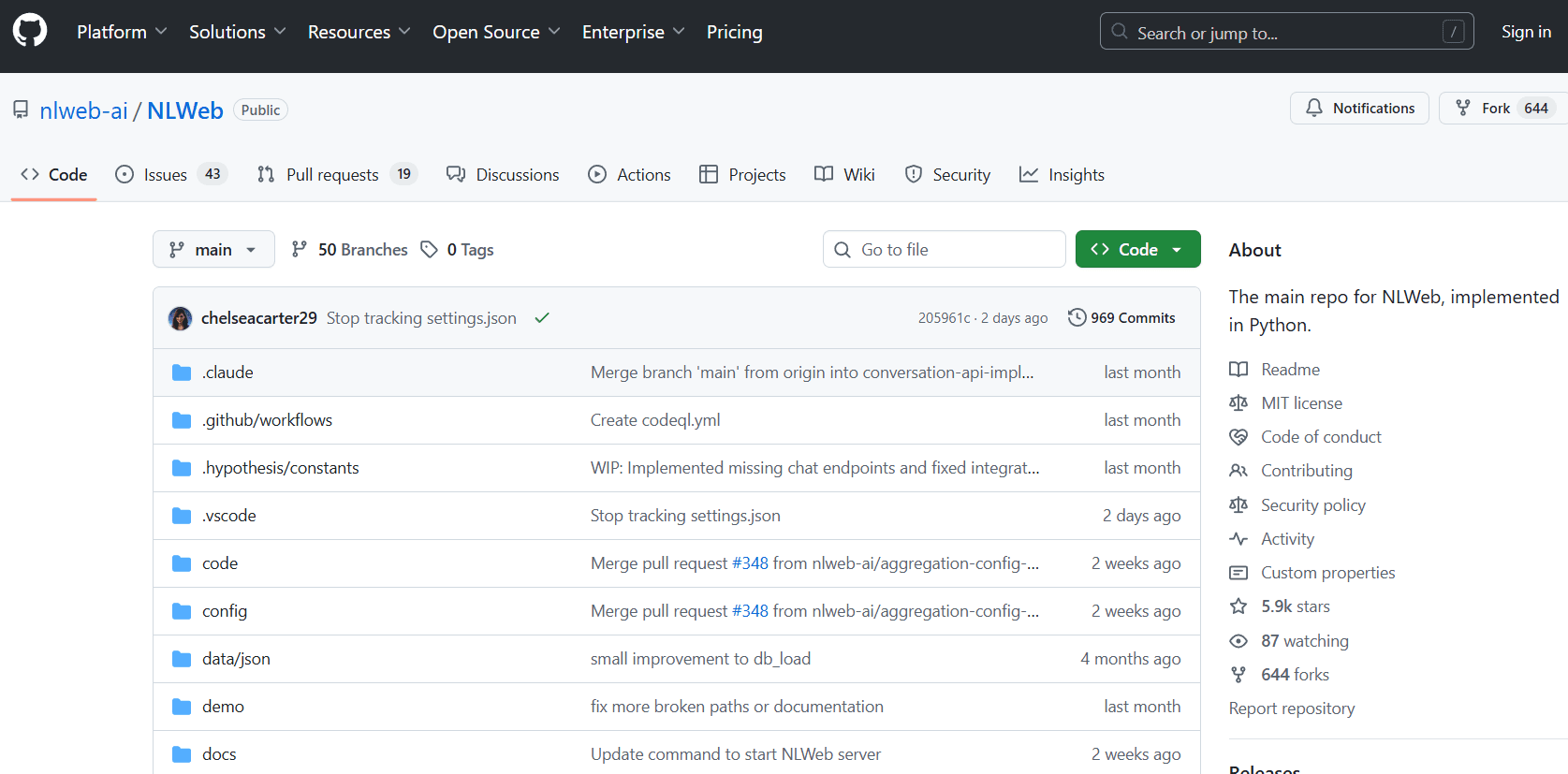
The Python GitHub repository is the very source code of the NLWeb protocol. It is not a finished product but a library to be deployed on your own Cloud infrastructure (Azure, AWS, GCP, Kubernetes) via Docker containers.
- Component Freedom: You have total control over your stack choice. You can connect the service to a wide range of LLMs (via connectors) and vector databases (Qdrant, Milvus, etc.).
- Custom Deployment: Developers deploy the service as a standalone API, often via a Docker container, and manage scaling logic through CI/CD tools.
Detailed Benefits
- Flexibility and Control: This is the most adaptable solution. You can switch between different LLMs to optimize cost or performance based on query tasks (e.g., a cheaper model for query rewriting, a more powerful model for response synthesis).
- Real-Time Integration: By connecting the service directly to your transactional databases (live), you avoid “freshness” index issues. Questions about current stock, price, or product availability receive factual and immediate answers.
- No Vendor Lock-in: You are not tied to a service provider like Cloudflare or the WordPress ecosystem.
Disadvantages and Warnings
- High Technical Expertise: This pathway is reserved for developers and ML/Cloud engineers. Configuring, deploying, managing models, and maintaining vector databases are complex tasks.
- Total Responsibility: Hosting costs, resilience, security (especially protecting LLM API keys), and updating dependencies rest entirely on your team.
The Value of NLWeb for the Future (SEO)
The NLWeb protocol transcends the simple chatbot functionality to become a discoverability imperative for the future of the web. Its most strategic value lies in its ability to make your site “Agent-Ready.” By adopting the Model Context Protocol (MCP), you are not just adding a search bar; you are speaking the same language as the next generation of AI assistants. Without this compatibility, your content risks becoming invisible to agents that will ultimately become the primary source of traffic. For semantic SEO, the contrast is striking: while traditional keyword search only finds what the user typed, advanced alternatives (Cloudflare or standalone implementation) use vector semantic search to understand what the user means. Even the simplest option, the WPNLWeb plugin, offers an immediate advantage by outputting structured responses in Schema.org, a tangible gain that makes your content more readable and relevant for all machines.
Comparison Table
| Feature | 1. WPNLWeb Plugin (Native WordPress) – under development | 2. Cloudflare AutoRAG/NLWeb (Managed Solution) | 3. Standalone Implementation (Python Repository) |
| Main Goal | Simple integration into the WordPress CMS. | Maximum performance and scalability for large sites. | Total flexibility and architecture customization. |
| Philosophy | Internal Solution. Uses hosting server resources. | External Solution (SaaS). Uses Cloudflare’s Edge network. | Open Source. Custom deployment on dedicated Cloud infrastructure. |
| Technical Complexity | Low (⭐) | Medium (⭐⭐) | High (⭐⭐⭐) |
| Performance/Speed | 🟡 Good, but limited by your hosting server’s resources. | 🟢 Very High (Under 500ms). Processing is offloaded to the Edge network (Workers). | 🟢 Optimal, entirely dependent on the chosen Cloud infrastructure (AWS, Azure, GCP). |
| Scalability | Medium. May encounter issues on very large sites or under heavy load. | High/Unlimited (Designed for 100k+ pages). Continuous indexing and updating. | Maximum. You manage scaling through your usual Cloud tools. |
| Search Quality | Native WordPress search (Keywords). Less precise than semantic. | Advanced Semantic Search (Uses Vectorize). Understands the concept of the query. | Depends on user choice (Vector database and LLM). |
| Data Control | Total. Data remains on your server. | Data is copied and indexed on Cloudflare’s infrastructure (Vectorize/R2). | Total. You choose where data is stored and processed. |
| Key Dependencies | PHP 7.4+, WordPress. | Cloudflare, AutoRAG, Workers AI, R2, Vectorize. | Python, Docker, a Cloud service (AWS/Azure/GCP), LLM API (OpenAI/Gemini/Anthropic). |
| Cost | Low (Free plugin), but may lead to increased hosting fees. | Variable. Subscription fees for Cloudflare services (AutoRAG/Workers). | Variable/Potentially High. Hosting, infrastructure, and LLM API usage costs. |
| Ideal Use Case | SME/Blog WordPress sites prioritizing simplicity. | Large enterprises or high-growth sites demanding the best performance. | Development teams seeking deep business integration or specific LLM customization. |
Conclusion
The need to make your content accessible to humans and machines 🤖 through natural language is no longer an option, but a future requirement for discoverability. The choice of alternative depends on your profile:
- If you are a WordPress publisher prioritizing simplicity and CMS integration, the WPNLWeb Plugin is your best starting point. It allows you to test the protocol and improve UX immediately. But you will have to wait a bit longer.
- If you are a performance-focused organization with Cloud scalability, adopting the Cloudflare AutoRAG/NLWeb solution gives you a head start by leveraging the power of Edge Computing and managed semantic search.
- Finally, if you are a development team with complex real-time integration needs, the Standalone Python Implementation provides the blank canvas necessary to create a custom NLWeb solution, perfectly integrated into your business infrastructure.
Whatever your choice, the important thing is to start adapting your site for this new chapter of the Internet, where every page has the potential to become an intelligent conversational application. I just tested the first 2 alternatives on 2 different sites, and I will keep you updated.
Frequently Asked Questions
Which solution is best for a small WordPress blog?
The WPNLWeb Plugin. It is the easiest to install and manage in the standard WordPress environment.
Which solution is the fastest?
Cloudflare AutoRAG/NLWeb. Processing is offloaded to Cloudflare’s Edge servers, ensuring speed and advanced semantic search.
Is coding knowledge necessary?
No, for the plugin and Cloudflare. Yes, for the Standalone Implementation (requires Python and Cloud skills).
Are these solutions expensive?
The WPNLWeb plugin is free and open-source but may increase the load on your hosting. The Cloudflare solution involves subscription fees for its services (AutoRAG, Workers, etc.). The standalone implementation has variable costs depending on the infrastructure and AI API usage you choose.
Can I use the Cloudflare solution if I don’t have a WordPress site?
Yes. The Cloudflare AutoRAG/NLWeb solution is CMS-agnostic. It crawls your site like a search engine, whether it’s on WordPress, Shopify, or any other technology.
Can NLWeb help my site appear in the responses of ChatGPT or other AI agents?
Yes, that is the main goal. By exposing your content via an NLWeb/MCP API, you allow AI agents to query it in a structured way and potentially use it to generate responses to users, thereby increasing the visibility and discoverability of your content.