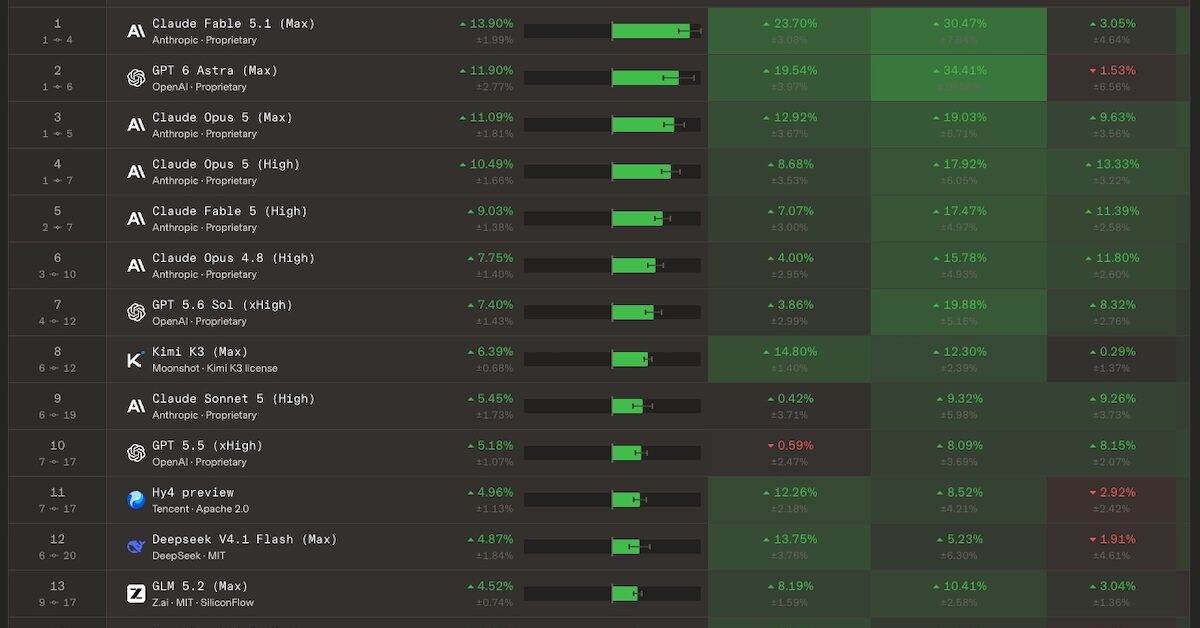
For a few months now, I have been closely following the evolution of AI models capable of piloting autonomous agents, and frankly, the landscape is changing at an impressive speed. In September 2026, the Arena ranking offers us a fascinating snapshot of this fierce competition among the AI giants. Claude Fable 5.1 from Anthropic takes the lead, but OpenAI is making a strong comeback with GPT-6 Astra, challenging the dominance that Anthropic had maintained for months. What particularly interests me is that this battle is not played out on traditional benchmarks, but on the actual ability of the models to execute complex tasks in a sandbox environment. With nearly 1.7 million user sessions analyzed, this ranking represents a true goldmine for understanding which models really perform when it comes to agentic automation. In this article, I propose to dissect this ranking, explore Arena’s revolutionary methodology, and show you how these models position themselves relative to each other.
Claude Fable 5.1: The New Reference for AI Agents
Claude Fable 5.1 has established itself as the undisputed champion of the agentic ranking of Arena in September 2026. Launched on September 1st, this model immediately took first place in its Max version, outpacing all its competitors. What makes this victory particularly remarkable is that it relies on real usage data rather than synthetic tests. I must admit that I was impressed by the consistency of performance of Claude Fable 5.1 across different types of tasks. The model achieves the highest rate of tasks validated by users, meaning that the results it produces truly match what people expect.
Anthropic has clearly invested heavily in optimizing its models for agentic tasks 🤖. The company’s strategy seems to be to create specialized models rather than generalist solutions. Claude Fable 5.1 represents this approach, with an architecture specifically designed to delegate complete workflows to an autonomous agent. The two versions of Claude Opus 5 complete the podium, occupying the third and fourth places, showing that Anthropic does not rely on a single model to dominate the agent market.
What fascinates me is the stability of Anthropic in this ranking. The company occupies six of the top ten spots, demonstrating a deep mastery of the challenges related to agentics. This contrasts sharply with the situation in August, where Anthropic held the top three spots without competition. The rise of OpenAI has forced Anthropic to remain vigilant, but Claude Fable 5.1 proves that the company has the resources and expertise to maintain its lead.
GPT-6 Astra: The Spectacular Return of OpenAI
GPT-6 Astra made a thunderous entry into the agentic ranking, placing directly in second position. Launched two days after Claude Fable 5.1, this model represents a major turning point for OpenAI in the race for AI agents. What particularly struck me is that GPT-6 Astra is the first OpenAI model ranked at the maximum cyber risk level, indicating a significant increase in its capabilities. The previous month, OpenAI’s best model was only in fourth place, so this spectacular rise deserves attention.
OpenAI has clearly worked hard to catch up in the field of autonomous agentics 🚀. GPT-6 Astra notably achieves the highest proportion of positive user feedback, suggesting that people really appreciate how this model interacts with them. However, there is a weak point: GPT-6 Astra is the only one in the top 10 to show a negative score on steerability, meaning its ability to integrate corrections when a user corrects it. This is an important detail that could explain why it did not take first place despite its excellent overall performance.
I believe that this performance from OpenAI signals a shift in market dynamics. For a long time, Anthropic seemed to have an undeniable lead in AI agents, but GPT-6 Astra shows that OpenAI understands the stakes and is investing heavily in this direction. The competition between the two giants is just beginning, and this is excellent for users who will benefit from faster innovations.
The Arena Methodology: How to Evaluate AI Agents
What makes the Arena ranking particularly credible is its revolutionary methodology called causal tracing. Unlike traditional benchmarks that use anonymized duels and Elo scores, Arena observes real sessions conducted in Agent Mode, its open sandbox environment launched in June 2026. I must admit that this approach seems much more relevant to me than synthetic tests, as it measures what really matters: performance in real usage conditions.
The Arena platform aggregates five key signals to create a unique score 📊. The first is the validation or rejection of the result by the user, which simply measures whether the model did what was asked of it. The second signal captures compliments and criticisms expressed in natural language, providing a qualitative perspective on satisfaction. The third evaluates the agent’s ability to integrate a correction when it is corrected, which is crucial for iterative workflows. The fourth measures the number of steps needed to recover from a failed command, and the fifth examines the model’s propensity to invoke tools it does not possess.
What impresses me about this methodological approach is that no model dominates all the signals. Claude Fable 5.1 excels in task validation, GPT-6 Astra in positive feedback, and the versions of Claude Opus 5 in integrating corrections. This means that each model has its strengths and weaknesses, and the choice of the best model really depends on your specific use case. This is an important nuance that simple rankings do not capture.
The Top 10 Models for Piloting Agents in September 2026
The complete ranking of the top ten models for AI agents in September 2026 reveals a clear hierarchy, but also some interesting surprises. In first place, we have Claude Fable 5.1 (Max), followed by GPT-6 Astra (Max), Claude Opus 5 (Max), Claude Opus 5 (High), Claude Fable 5 (High), Claude Opus 4.8 (High), GPT-5.6 Sol (xHigh), Kimi K3 (Max), Claude Sonnet 5 (High), and GPT 5.5 (xHigh). What strikes me is the overwhelming dominance of Anthropic, which occupies six of the top ten spots, compared to three for OpenAI.
Kimi K3, the open weight model from Moonshot AI, drops from fifth to eighth place, while GPT-5.6 Sol, which held the podium’s bottom position in August, is now seventh 📈. This volatility in the ranking shows that the AI agent market is extremely dynamic. Behind the top 10, the pack is tightening considerably. Hy4 preview from Tencent appears in 11th position, followed by DeepSeek V4.1 Flash, GLM 5.2 from Z.ai, and Muse Spark 1.3 from Meta. In August, one had to go down to 13th place to encounter another player besides Anthropic, OpenAI, or Moonshot AI, and to 22nd to see Meta. This shows that the market concentration has slightly decreased, with other players beginning to emerge.
Google remains distant with Gemini 3.6 Flash in 34th position, while Mistral, the only European player in the table, ranks in 41st position. I must admit that I am a bit surprised by the relative weakness of Google and Mistral in this ranking. Both companies have excellent models, but they seem not to have optimized their solutions specifically for agentic tasks. This is an opportunity for them to catch up by investing more in this direction.
Anthropic Dominates, But Competition Intensifies
The dominance of Anthropic in the agentic ranking is undeniable, but it hides a more nuanced reality. Yes, Anthropic occupies six of the top ten spots, but the rise of OpenAI with GPT-6 Astra shows that competition is intensifying. I believe we are witnessing a pivotal moment where the AI agent market is beginning to structure itself around a few major players. Anthropic has clearly invested heavily in this direction, and it is paying off, but OpenAI is not going to stay behind.
What particularly interests me is Anthropic’s strategy of creating multiple specialized models rather than a single generalist model. Claude Fable 5.1, Claude Opus 5, Claude Fable 5, and Claude Sonnet 5 all offer different performance profiles 🎯. This approach allows users to choose the model that best fits their specific needs, whether it is maximum performance or cost efficiency. OpenAI seems to be following a similar strategy with its different versions of GPT, but Anthropic clearly has a lead in execution.
The presence of other players like Moonshot AI, Tencent, DeepSeek, and Meta in the ranking shows that the AI agent market is not a duopoly. However, concentration remains very high, with Anthropic and OpenAI largely controlling the best performances. I think we will likely see a consolidation of the market in the coming months, with some players managing to carve out a place, while others will disappear or be acquired. The competitive dynamics of the sector create opportunities for innovators.

Implications for Businesses and Developers
For businesses and developers looking to build solutions based on AI agents, this ranking offers valuable insights into which models to use. If you need the best possible performance and cost is not a major concern, Claude Fable 5.1 seems to be the obvious choice. However, if you are looking for a good balance between performance and cost, or if you prefer to work with OpenAI, GPT-6 Astra is now a very viable option. I highly recommend testing several models with your specific use cases before making a decision, as performance can vary significantly depending on the type of task.
What concerns me a bit is that most of the best models for AI agents are proprietary and controlled by large companies. This means that developers and businesses are heavily dependent on these providers for their critical solutions. I believe there is an opportunity for open-source models to catch up in the field of agentics 💡. Projects like DeepSeek and Mistral show that it is possible to create high-performing models outside the ecosystem of tech giants, but they clearly have a long way to go to compete with Claude and GPT.
For teams looking to implement a automation strategy based on AI agents, this ranking is a valuable resource for evaluating the tools and models to use. I recommend regularly checking the Arena ranking to stay updated on the latest performances, as the landscape is changing rapidly. To learn more about how to create an AI agent to automate your marketing monitoring, check out our detailed guides that will help you deploy these technologies effectively.

Conclusion
The agentic ranking of Arena in September 2026 offers us a fascinating snapshot of the current state of competition in the field of AI agents. Claude Fable 5.1 from Anthropic remains the undisputed champion, but GPT-6 Astra from OpenAI shows that the battle is just beginning. What truly impresses me is the sophistication of Arena’s methodology, which measures real performances rather than synthetic results. This gives us a much better understanding of what really works when it comes to piloting autonomous agents. I am convinced that this ranking will become a must-reference for anyone looking to understand the landscape of AI models for agentics.
Looking ahead, I believe we will see an intensification of competition between Anthropic and OpenAI, with other players trying to carve out a place. Businesses and developers who quickly adopt the best models for AI agents will have a significant competitive advantage. If you are looking to implement an automation strategy based on AI agents, I recommend consulting this ranking and testing the top-performing models with your specific use cases to maximize your return on investment.
📝 In Brief
- Claude Fable 5.1 from Anthropic takes the lead in the Arena agentic ranking in September 2026 with the highest rate of tasks validated by users
- GPT-6 Astra from OpenAI spectacularly rises to second place, showing that competition is intensifying in the field of AI agents
- Arena’s causal tracing methodology measures real performances based on 1.7 million user sessions, providing a more reliable assessment than synthetic benchmarks
- Anthropic dominates the top 10 with six models, while Google and Mistral remain distant, creating an opportunity for emerging players to catch up