For several months now, I have noticed that AI agents are becoming increasingly sophisticated, but they still face a major obstacle: the quality of the context provided to them. This is a fundamental problem that Google has decided to tackle head-on with the Open Knowledge Format (OKF), an open standard unveiled on June 12, 2026. After studying this innovation, I am convinced that it marks a turning point in how organizations will structure and share their knowledge. Rather than multiplying isolated technological bricks, the OKF proposes a radically different approach: a common, neutral, and accessible format for all. In this article, I will explain why AI agents needed such a solution, how it works in practice, and most importantly, what it changes for digital professionals like you and me. You will discover that the OKF is not just a technical tool, but a new philosophy of knowledge management in business.
Why AI Agents Need a Common Knowledge Format
Imagine an extremely powerful language model capable of processing billions of parameters. Despite all this power, it does not understand the meaning of a specific metric for your business, nor the schema of an internal data table, nor even the procedure to follow in the event of a critical incident. This is the frustrating reality faced by teams deploying AI agents today. These business knowledge elements, absolutely essential for agents to function correctly, are scattered across systems that do not communicate with each other: metadata catalogs with their own APIs, internal wikis, shared drives, comments in the code, and sometimes only in the minds of a few experienced engineers 🧠.
Every time a team builds a new agent, it must reconstruct this context from disparate and incompatible sources. This is a repetitive, costly, and error-prone task. Each editor reinvents its own data model, and knowledge remains trapped in the tool that produced it. I see this as a real waste of resources. For Google, the answer to this problem is not yet another proprietary service, but something more fundamental: an open format that anyone can produce without complex SDKs, consume without laborious integration, and that survives the transition from one system to another.
This philosophy distinguishes the OKF from previous solutions. Instead of creating a new centralized platform, Google offers a standardized way to represent knowledge. This approach seems much more sustainable and inclusive to me, as it does not force organizations to depend on a single vendor. The OKF thus becomes a common infrastructure on which anyone can build, without fear of technological lock-in.

How the Open Knowledge Format Works in Practice
In its version 0.1, the OKF is intentionally minimalist, and that is precisely what makes it strong. It formalizes what researcher Andrej Karpathy called the “LLM-wiki pattern,” a simple yet powerful idea: entrust the maintenance of a knowledge base to an AI, because LLMs “never get tired and never forget to update a cross-reference.” Specifically, an OKF base relies on three fundamental principles that make the format accessible to everyone. First, simple Markdown: readable in any text editor, directly displayable on GitHub, and indexable by any search tool. No need for proprietary interfaces or specialized software 📝.
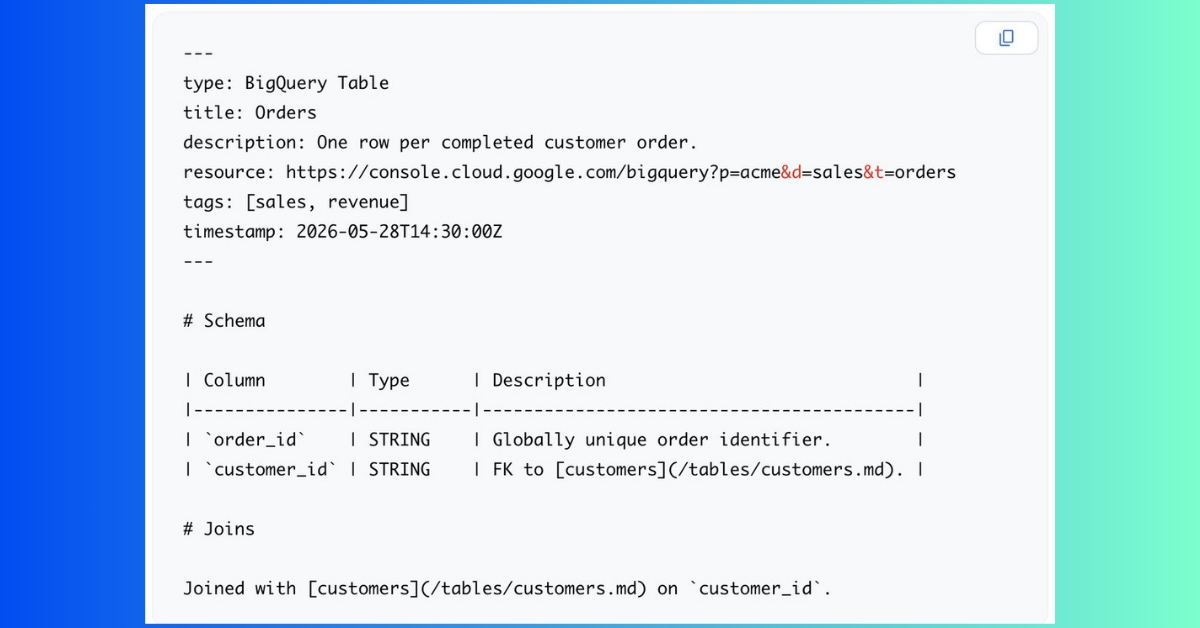
Next, simple files: deliverable as a ZIP archive, hostable in a standard Git repository, and accessible from any file system. This simplicity is revolutionary compared to complex databases. Finally, YAML in the header for the small set of structured fields that must remain queryable: type, title, description, resource, tags, and timestamp. Each file describes a “concept”: a table, a dataset, a metric, a procedure, or an API. Its path in the hierarchy serves as a unique identifier, and concepts are linked together by simple Markdown links.
Thus, the whole forms a knowledge graph, much richer than a simple folder hierarchy. A complete folder (what Google calls a “bundle”) can also contain index files to guide the agent in its navigation, and a change log. To make the format concrete, Google has published its specification on GitHub, accompanied by several reference implementations: an agent capable of automatically documenting a BigQuery dataset, an HTML viewer that transforms an OKF base into an interactive graph, and three ready-to-use examples. The Knowledge Catalog of Google Cloud can already natively ingest the format.
OKF and RAG: Two Complementary Approaches, Not Competitors
A common question arises: what is the difference between the OKF and Retrieval-Augmented Generation (RAG)? This is an excellent question, as the two concepts are related but play distinct roles. RAG is a retrieval technique: at the time of a query, the system searches for relevant documents and injects them into the context of the language model. The OKF, on the other hand, is a representation format that organizes knowledge upstream, even before the agent asks a question 🔍.
The two complement each other perfectly. Rather than loading an entire massive documentation base into the context window to apply RAG, an agent can browse an OKF bundle and only fetch the truly useful concepts. This is much more efficient. The OKF structures knowledge intelligently, while RAG (and then the agent) exploits it. I see the OKF as the foundation of a house, and RAG as the way to move around in it. You can have an excellent RAG, but if your knowledge is not well-structured, you will retrieve relevant but fragmented information. With the OKF, you have a solid and coherent foundation on which to build.
This complementarity is important for teams deploying AI agents to understand. It is not one or the other; it is both together. The OKF provides the structure, RAG provides intelligent access. Together, they create a system where agents can navigate and exploit an organization’s knowledge smoothly and accurately.

What the OKF Changes for Digital Professionals
If the OKF primarily targets data teams and developers, its logic could largely overflow this framework. For SEO and marketing professionals, it extends a shift already underway with the rise of AI agents. We are no longer just looking to be found by traditional search engines, but to make our knowledge directly usable by agents capable of acting. This is a major paradigm shift. Some specialists see it as the emergence of a new expertise, consisting of transforming the scattered knowledge of a company into a structured and actionable base 💡.
For marketing teams, this means that the documentation of your products, processes, and data must be thought of differently. It is no longer just for humans reading a web page; it is also for AI agents that will query this knowledge. I believe that organizations that adopt the OKF first will have a significant competitive advantage. They will be able to deploy smarter, faster, and more reliable agents. The digital transformation will no longer just be a matter of technology, but of structuring knowledge.
However, the format is still in its early stages. Google itself presents OKF v0.1 as a starting point, set to evolve based on community feedback. Most importantly, the value of such a standard depends on the number of actors who adopt it. Published by Google but designed to be neutral with respect to platforms, the OKF will only fulfill its promises if a true ecosystem of producers and consumers develops around it. This is a collective challenge, not just an initiative of a single actor.
Towards a New Era of Knowledge Management
By observing the evolution of AI and automation tools, I am convinced that the OKF represents a crucial step. We are moving from an era where knowledge was locked in technological silos to an era where it can flow freely between systems. It is comparable to the revolution of the open web: instead of having proprietary databases, we have HTML pages that any browser can read. The OKF does the same for structured knowledge 🌐.
The implications are profound. Small businesses will be able to build sophisticated AI agents without relying on a single platform. Large organizations will be able to integrate tools from different vendors more easily. Researchers and developers will have access to better-structured data. This is a move towards greater interoperability, more transparency, and more control for users. I see the OKF as a key piece in building a decentralized and sustainable AI infrastructure.
Conclusion
The Open Knowledge Format is not just another technical format. It is a philosophical response to a fundamental problem: how to structure and share an organization’s knowledge in a way that AI agents can exploit it effectively? I am convinced that the OKF will become an essential standard in the coming years, just as JSON or XML have been for data. Organizations that understand its importance and adopt it early will have a significant strategic advantage.
For you, a digital professional, this means it is time to start thinking about structuring your knowledge. How do you document your processes? How is your data organized? How could you make it usable by AI agents? These questions will become central in digital strategies over the next three years. The OKF gives you the tools to answer them.
📝 In Brief
- The OKF is an open standard created by Google to structure business knowledge in a way that is usable by AI agents
- The format is based on three simple principles: Markdown, standard files, and YAML for metadata
- The OKF complements RAG by providing a solid base structure that agents can navigate intelligently
- The adoption of the OKF will transform how organizations manage and share their knowledge with AI systems