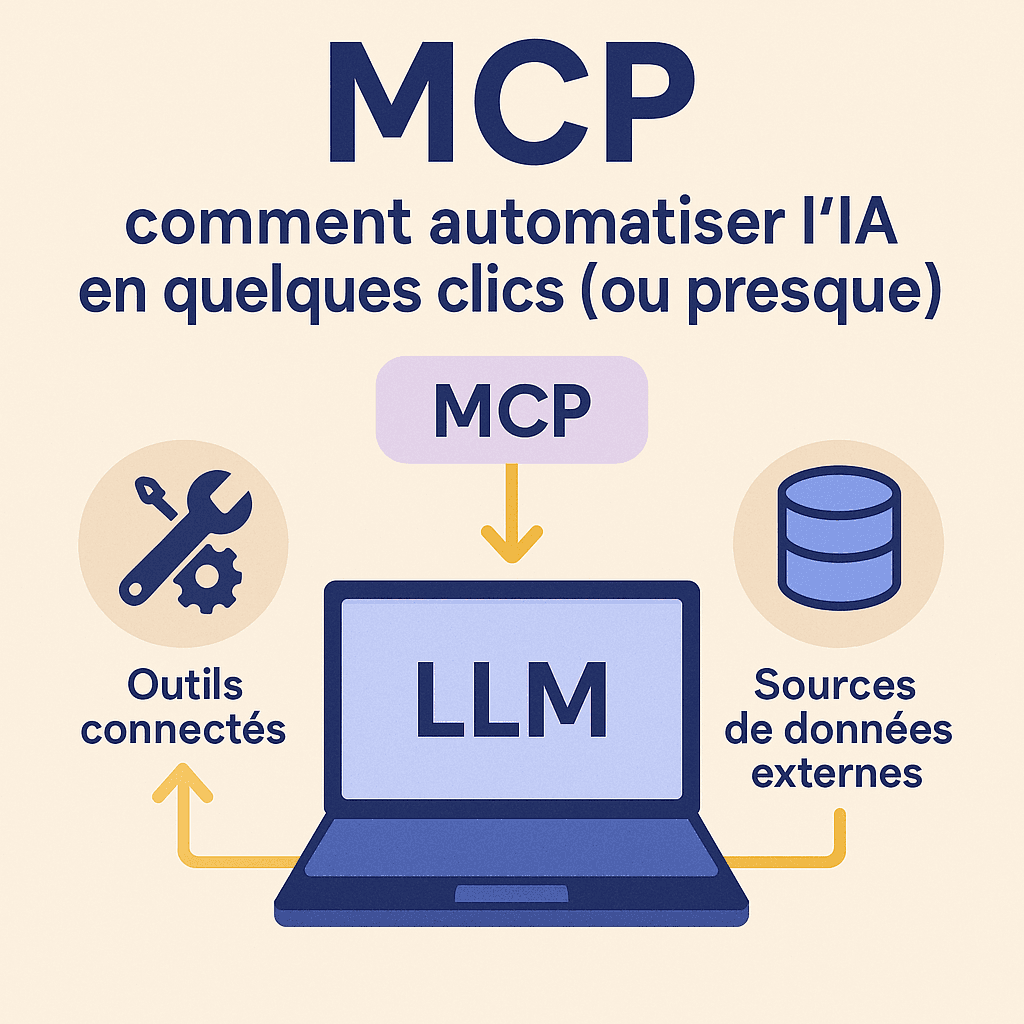
In the bubbling universe of artificial intelligence, few innovations provoke a change as fundamental as the Model Context Protocol (MCP). Unveiled by Anthropic at the end of 2024, the MCP is not just an additional protocol in the technological ecosystem. It could very well become the equivalent of the USB-C standard for AI: a universal, simple, and powerful connector capable of transforming conversational agents into true orchestrators of business tools.
By enabling large language models (LLMs) to understand, act, and integrate directly with an organization’s data and systems, the MCP opens a new era of intelligent automation. Here’s everything you need to know about this protocol that could reshape the landscape of information systems.
What is the Model Context Protocol?
The Model Context Protocol (MCP) is a standardized communication protocol designed to connect AI models — particularly LLMs — to databases, business applications, and other systems via real-time accessible tools.
It is based on a classic client-server architecture, but adapted to the requirements of modern AI models:
- Host: The application that hosts the LLM (e.g., Claude Desktop).
- MCP Client: Integrated into the host, it sends and receives requests.
- MCP Server: An intermediary interface that exposes tools usable by the AI to read, write, or interact with external resources.
Exchanges are made in JSON-RPC 2.0, a lightweight and standardized format that facilitates interoperability. Each MCP server exposes specific capabilities (for example: accessing a Gmail account, interacting with a local file system, manipulating a MongoDB database).
👉 In summary, the MCP transforms a passive AI model into an autonomous agent capable of acting within its environment.
Why is the MCP a revolution?
Before MCP, connecting AI to business tools required:
- A lot of specific development (custom APIs, middleware).
- Heavy manual integrations.
- Increased security and maintenance risks.
With MCP, everything becomes simpler:
- Standardization: No matter the application, if it exposes an MCP server, it is automatically usable by the AI.
- Plug & Play: A few minutes are enough to connect an existing server.
- Integrated security: Each action is explicitly validated, allowing for precise control of operations.
Some experts speak of “programming by use“: instead of coding behaviors, tools are exposed, and the AI dynamically chooses how to use them according to the context.
How does the MCP work in practice?
Let’s take the example of Claude Desktop:
- Installation of the MCP server: Let’s say you want your AI to manage your emails. You install a “Gmail” MCP server (open source on GitHub).
- Configuration: You edit a configuration file (
claude_desktop_config.json) to specify the server address. - Usage: During a prompt (“Send an email to my team”), Claude detects that it has access to the “sendEmail” tool via the Gmail MCP server. It formulates a request, the user validates the action, and the email is sent.
Simplified architecture:
cssCopierModifier[Claude Desktop] <—> [MCP Client] <—> [Gmail MCP Server] <—> [Gmail API]
Each MCP server offers:
- A list of accessible tools.
- Their description.
- The expected format of inputs and outputs.
It’s exactly like giving an “intelligent toolbox” to the AI.
An Exploding MCP Ecosystem
Since Anthropic’s announcement, hundreds of MCP servers have been created, covering all possible uses:
| Category | Examples |
|---|---|
| Communication | Gmail, Slack, Discord |
| Project Management | Linear, Notion, Monday.com |
| Databases | MongoDB, Redis, PostgreSQL |
| Development | GitHub, GitLab, Azure DevOps |
| Home Automation | Home Assistant |
| Data & Analytics | BigQuery, Databricks |
| Web Search | Tavily, Kagi |
| Generative AI | Replicate (images) |
| SEO | Ahrefs, Semrush, Clearscope, Surfer SEO |
Even OpenAI, a competitor of Anthropic, has announced that ChatGPT Desktop will soon support MCP. This shows the scale of the movement.
MCP and the Rise of Autonomous Agents
The MCP is not an isolated innovation. It is part of the wave of autonomous agents.
An autonomous agent is an AI capable of planning, reasoning, using tools, and acting without constant human supervision. It combines:
- Reasoning (planning actions).
- Tools (via API/MCP).
- Collaboration (working between agents).
The MCP protocol allows agents to:
- Identify dynamically the necessary tools.
- Adapt in real-time to business needs.
- Automate complex workflows.
Concrete example: an agent can analyze monthly sales in BigQuery, prepare a report in Notion, and send a summary via Slack… without human intervention.
What Challenges for Businesses?
The study “AI Decision Matrix” by AI Builders Research shows that the adoption of MCP poses new challenges for IT departments:
- Interoperability: How to properly integrate these new flows into existing information systems without generating instability?
- Governance: Who validates the actions initiated by the agents?
- Security: How to ensure that access to tools is controlled?
👉 A new generation of IT architectures is emerging, more open, agent-centric, where intelligence is distributed among models, tools, and APIs.
A Future Standard for Distributed AI
If the MCP succeeds in its mission, it could become:
- For AI agents what REST has been for the Web.
- A recognized interoperability standard on a large scale.
- The foundation of safe and maintainable industrial agent ecosystems.
Today, each MCP server exposes its tools as a set of formalized capabilities. Tomorrow, companies could publish their “MCP stacks” just as they publish public APIs.
General Architecture of the MCP Explained for Dummies
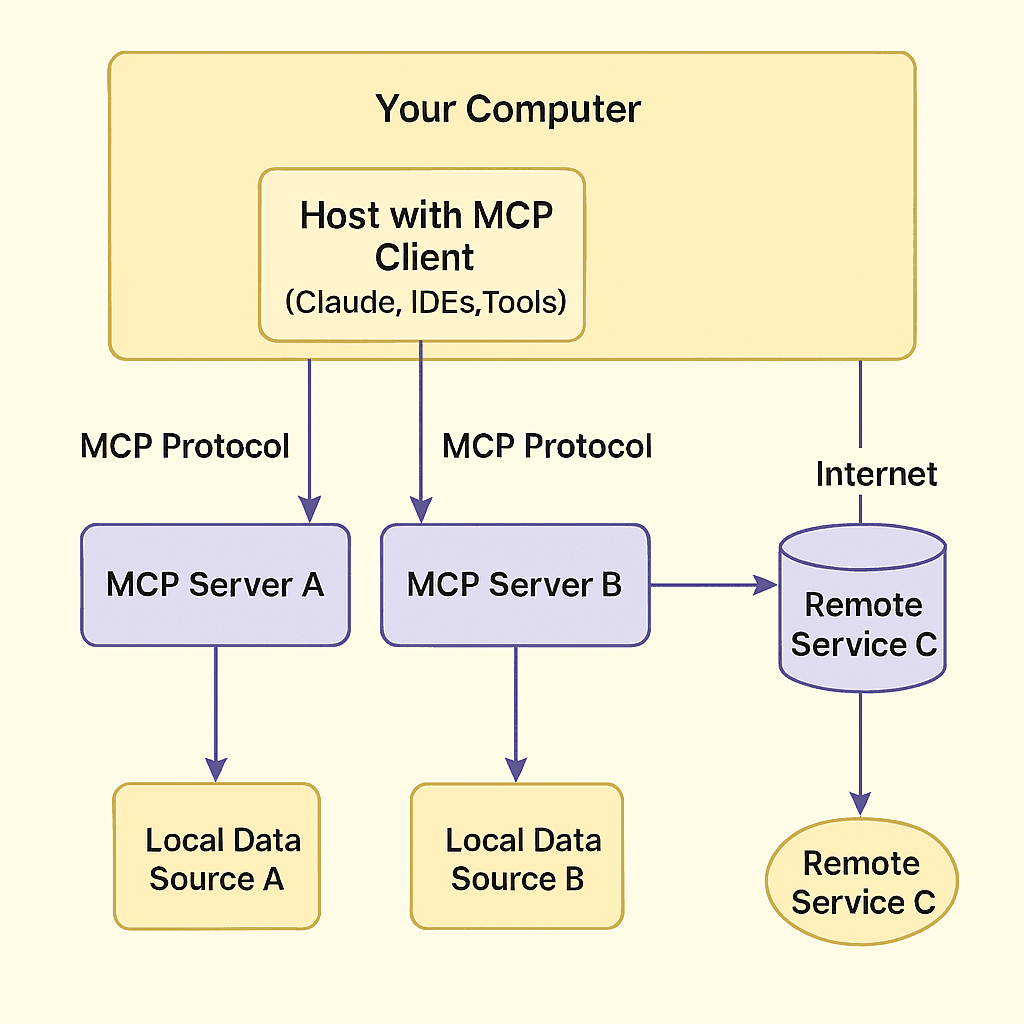
Host with an MCP client:
- The Host (your computer) contains an MCP client (could be Claude, an IDE, or other tools).
- This client communicates with several MCP servers via the MCP protocol.
2. MCP Servers:
- MCP Server A: connected to a local data source A.
- MCP Server B: connected to a local data source B.
- MCP Server C: connected to a remote service C via Web APIs.
3. Connections:
- Each server communicates with the client via the MCP protocol.
- Then, the MCP servers each communicate with their respective data sources (local or remote).
4. Summary:
- The MCP client is the central point that interacts with multiple MCP servers.
- These MCP servers manage either local sources (e.g., local databases) or remote services (via the Internet).
- This architecture allows an MCP tool to communicate transparently with different local databases and remote services without worrying about the underlying implementation details.
Conclusion: MCP, Towards a New Era of Connected AI
The Model Context Protocol is much more than a technical evolution: it is a paradigm shift. By making AIs actionable, contextually intelligent, and interoperable, the MCP unleashes a wave of innovations in intelligent automation. Autonomous agents, agile information systems, orchestration of complex tasks… Everything becomes possible with a few lines of JSON and a bit of configuration. For businesses, the time is not for resistance but for anticipation. Because, as often in tech, those who equip themselves early will reap the greatest benefits.
In my opinion, the MCP will establish itself as an essential standard in the coming months for all AIs on the market. This protocol will enable artificial intelligences to interact effectively with various tools through simple prompts. I am convinced that this technology will experience significant growth and become a reference in the field.