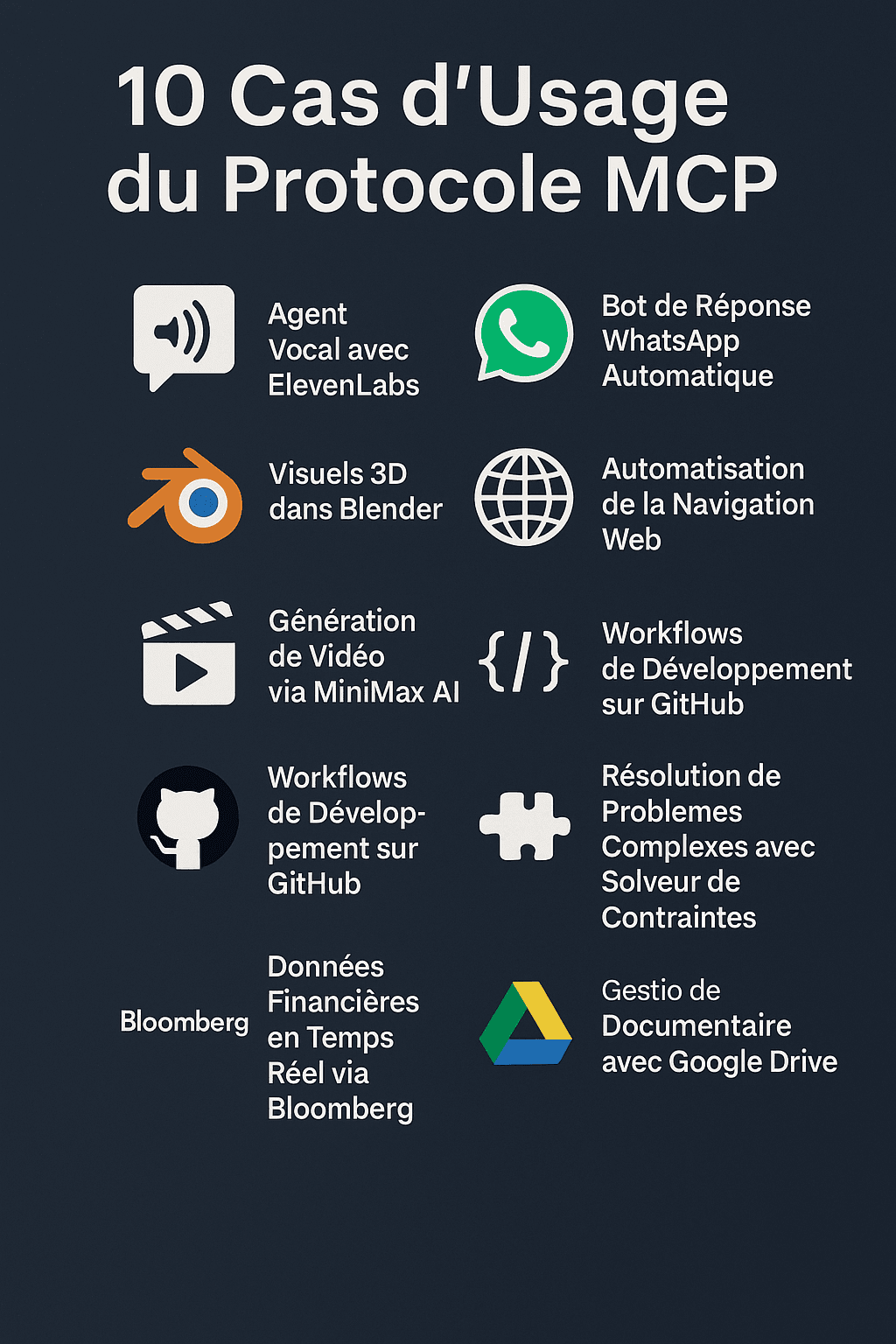
The Model Context Protocol, or MCP, is revolutionizing the world of artificial intelligence. This protocol allows large language models (LLMs) to go beyond text-based responses: they can now interact directly with software, databases, or web services. From creating 3D visuals to financial analysis and automating communication, MCP acts as a bridge between the virtual world of AIs and real tools. Here are 10 concrete use cases that I discovered illustrating the power of this protocol 🚀.
Creation of Customized Voice Agents (ElevenLabs)
The elevenlabs-mcp server allows for the creation and deployment of intelligent voice agents in just a few lines of prompts. By coupling this technology with Claude Desktop and the Twilio API, operational callbots can be generated in real-time. For example, a company can program an agent to automatically call its former clients to investigate the reasons for their disengagement. The agent is capable of conducting a smooth conversation, asking questions tailored to the received answers, and maintaining a courteous and professional tone. I find that this type of automation not only saves time but also gathers valuable insights to optimize retention strategies. Voice scripts are fully customizable, and semantic analysis modules can be integrated to identify patterns in customer feedback. This capability also paves the way for more complex uses such as appointment scheduling or first-level customer support management.
Automation of Voice Messages on WhatsApp
Thanks to the integration between elevenlabs-mcp and whatsapp-mcp, it becomes possible to automatically manage voice exchanges on WhatsApp. The system operates in three steps: transcription of incoming voice messages, generation of appropriate responses via LLM, and conversion of these responses into audio messages, possibly in the user’s voice. This technology is particularly useful for highly solicited professionals, such as consultants, salespeople, or influencers, who wish to maintain personalized interaction with their contacts while saving considerable time. For example, an entrepreneur can configure the AI to automatically respond to common customer inquiries while preserving a friendly and natural tone. The model can also be trained to filter urgent requests and alert the user in case of a priority message. By combining this feature with a connected calendar, I believe the agent can also propose appointment slots or confirm availability.
Generation of 3D Visuals in Blender
The blender-mcp server uses Blender’s Python API to allow LLMs to automatically generate 3D scenes in response to textual instructions. One of the most striking uses is to create simple objects for prototypes, video games, or visual demonstrations. For example, a designer can ask the AI to model a minimalist floral object with a stem and symmetrical white petals. The result can then be customized, animated, or exported for integration into other tools. For beginners (like me 😅), this represents a huge time saver, allowing them to visualize their ideas without advanced technical skills. The agent can also be configured to follow specific specifications: dimensions, textures, color palettes, or precise geometric shapes. One can also go further by integrating automatic rendering logic (shading, lighting, camera) to produce previewable renders.
Web Navigation Automation (Playwright)
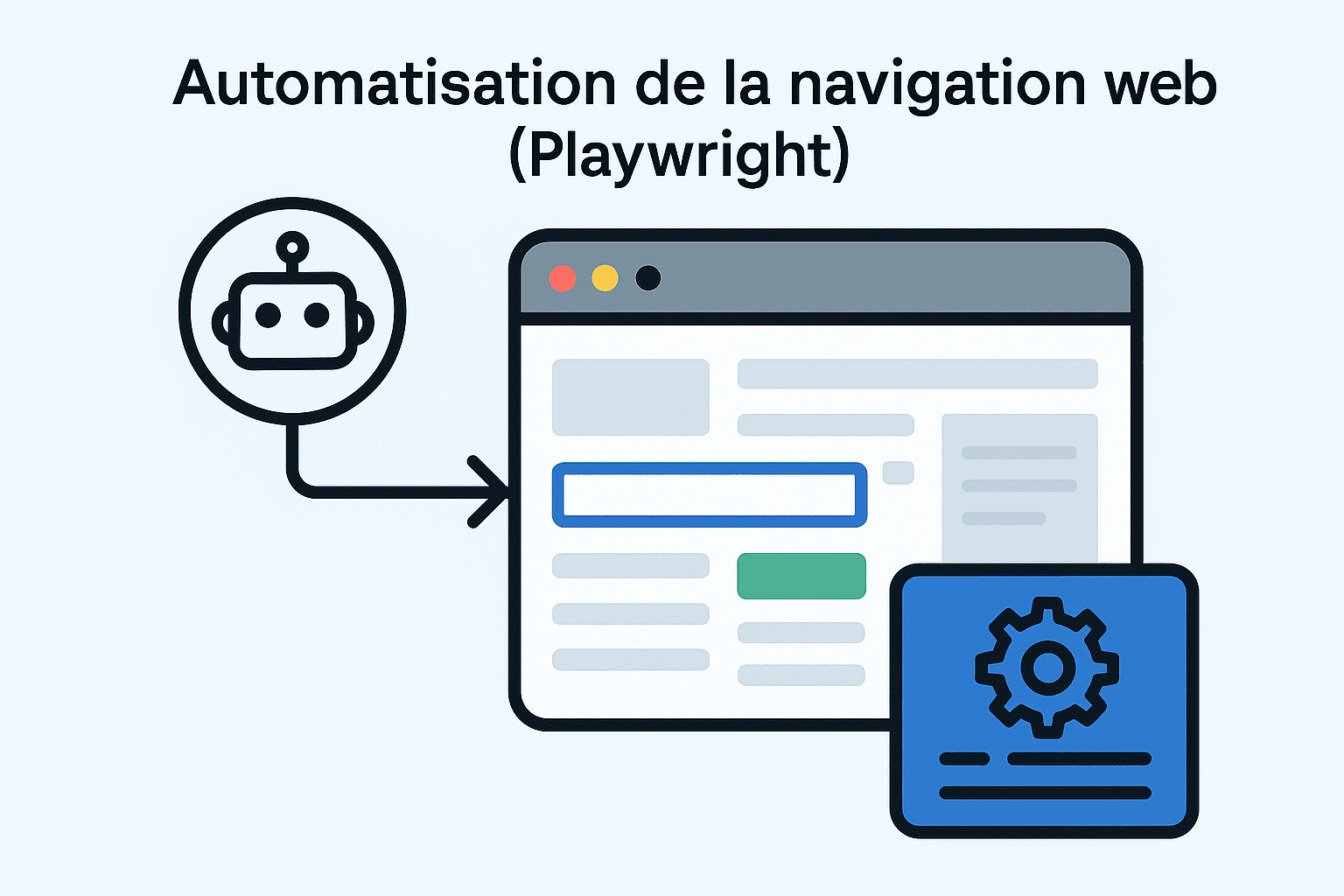
This use case is my favorite. The playwright-mcp server, developed by Microsoft, revolutionizes the automation of web tasks. Unlike other solutions based on screenshots, this server uses a structural reading of HTML elements to interact effectively with websites. A concrete example: conducting daily monitoring of technology news. The AI agent can visit dozens of specialized sites (TechCrunch, VentureBeat, MIT Review…), extract relevant articles, summarize them, and send a structured report via email. It is even possible to rate each source based on its reliability and automatically archive the links. This use case can be adapted to monitor competitors, search for tenders, or collect product data on marketplaces. Thanks to the integration with Gmail via MCP, sending reports is immediate, with a clean and readable HTML layout.
Automated Video Creation (MiniMax)
MiniMax-MCP takes visual content generation further by automating video production. The AI is not only used to produce a video from a classic prompt: it is also capable of creating an optimized prompt for text-to-video models. This means that the LLM understands the desired scene (atmosphere, visual elements, style, movement) and reformulates these intentions in a language compatible with MiniMax’s video engine. For example, a user can describe a sunset scene in a futuristic city, and the system will generate a detailed prompt tailored to technical constraints. This method significantly improves the quality of generated videos, making the content more faithful to the creative intent. This technology is ideal for content creators, marketing teams, or trainers looking to enhance their presentations. I can’t wait to see what’s next.
Access to Real-Time Financial Data (Bloomberg)
With bloomberg-mcp, AIs can connect to the BLPAPI to access live financial data. This includes stock prices, analyses, sector trends, currencies, and commodities. A concrete case: the AI can list the 10 S&P 500 stocks with the lowest P/E ratio, useful for spotting undervalued stocks. But that’s not all. The user can also set up an automated dashboard to track key financial indicators, receive alerts on abnormal variations, or produce a weekly analysis report. This transforms LLMs into true assisted financial analysts 💰, capable of providing real-time information useful for decision-making. These agents can also cross-reference data with economic news or company results to derive comprehensive analyses.
Automation of GitHub Workflows
By connecting an LLM to GitHub via a dedicated MCP server, it becomes possible to automate entire workflows: creating repositories, pushing files, automatically generating READMEs, commenting on pull requests, etc. The AI can even conduct code reviews according to a defined style or convention. This allows, for example, a team of developers to collaborate more effectively, reducing friction related to manual processes. A well-constructed prompt can trigger a series of actions: cloning a repo, running tests, deploying a version to a staging environment, and notifying team members. For open source projects, this also allows sorting issues, proposing fixes, or guiding beginner contributors through automatically generated personalized messages.
Interaction with Mathematical Constraint Solvers
LLMs can be connected to formal solvers (like Z3 or Gurobi) to solve complex mathematical problems. For example, in the context of a logistics optimization project, the AI can transform a statement in natural language (minimizing delivery costs while respecting stock and deadline constraints) into a formal mathematical problem. MCP then allows sending this problem to the solver, analyzing the returned solutions, and proposing adjustments or interpretations. This capability is crucial for fields such as engineering, sciences, economics, or urban planning. It also opens the door to AI-assisted teaching, with agents capable of rigorously and explainably correcting exercises.
Integration with IDEs like Replit or Codeium
With a compatible MCP server, I have seen that an AI assistant can code live in environments like Replit. It can write, correct, test, and structure programs following natural instructions. This mode of interaction is perfect for programming students, freelance developers, or even teachers. One can imagine a prompt asking the AI to create a web application in React with authentication, a database, and deployment on Vercel. The agent manages the entire chain while documenting each step. The IDE thus becomes a real-time collaboration space with an AI that understands intentions, common errors, and proposes solutions without having to leave the work context.
Document Management in Google Drive
Thanks to a MCP server dedicated to Google Drive, LLMs can interact with documents, presentations, and spreadsheets stored in the cloud. An assistant can automatically search for files, read them, synthesize them, generate new reports from templates, or even schedule the sending of these documents. This use case is particularly useful for HR managers, project leaders, or salespeople who handle a large number of files daily. For example, a prompt can request the automatic generation of a monthly performance report from the time sheets entered in Google Sheets, then integrate the results into a customized Google Slides presentation, ready to be shared with management.
Conclusion
The MCP protocol is becoming a central piece in the AI ecosystem. It transforms language models into agents capable of acting concretely in the digital world. These 10 use cases are just a taste of the possibilities offered. In the coming months, we can expect a multiplication of MCP servers, making AI increasingly useful, proactive, and grounded in reality.
I see in MCP a revolution comparable to the arrival of the first visual platforms like Zapier or Bubble. Where these tools allowed non-developers to create automations and apps without writing a line of code 💻, MCP pushes the concept even further: it offers LLMs the ability to become intelligent orchestrators, capable not only of following a defined scenario but also of adapting in real-time to data, user behaviors, or analytical results. In the field of web analytics, for example, one can imagine an AI agent connected to an MCP server capable of continuously analyzing a site’s performance, cross-referencing conversion data with user behaviors, and then proposing (or even executing) concrete actions: modifying a landing page, triggering an email campaign, or testing a new offer.
MCP does not just automate artificial intelligence: it makes it operational and contextual. The future of intelligent workflows will no longer rely solely on fixed scenarios but on agents capable of understanding, deciding, and acting. For digital professions, from marketing to project management and engineering, this represents a profound paradigm shift.