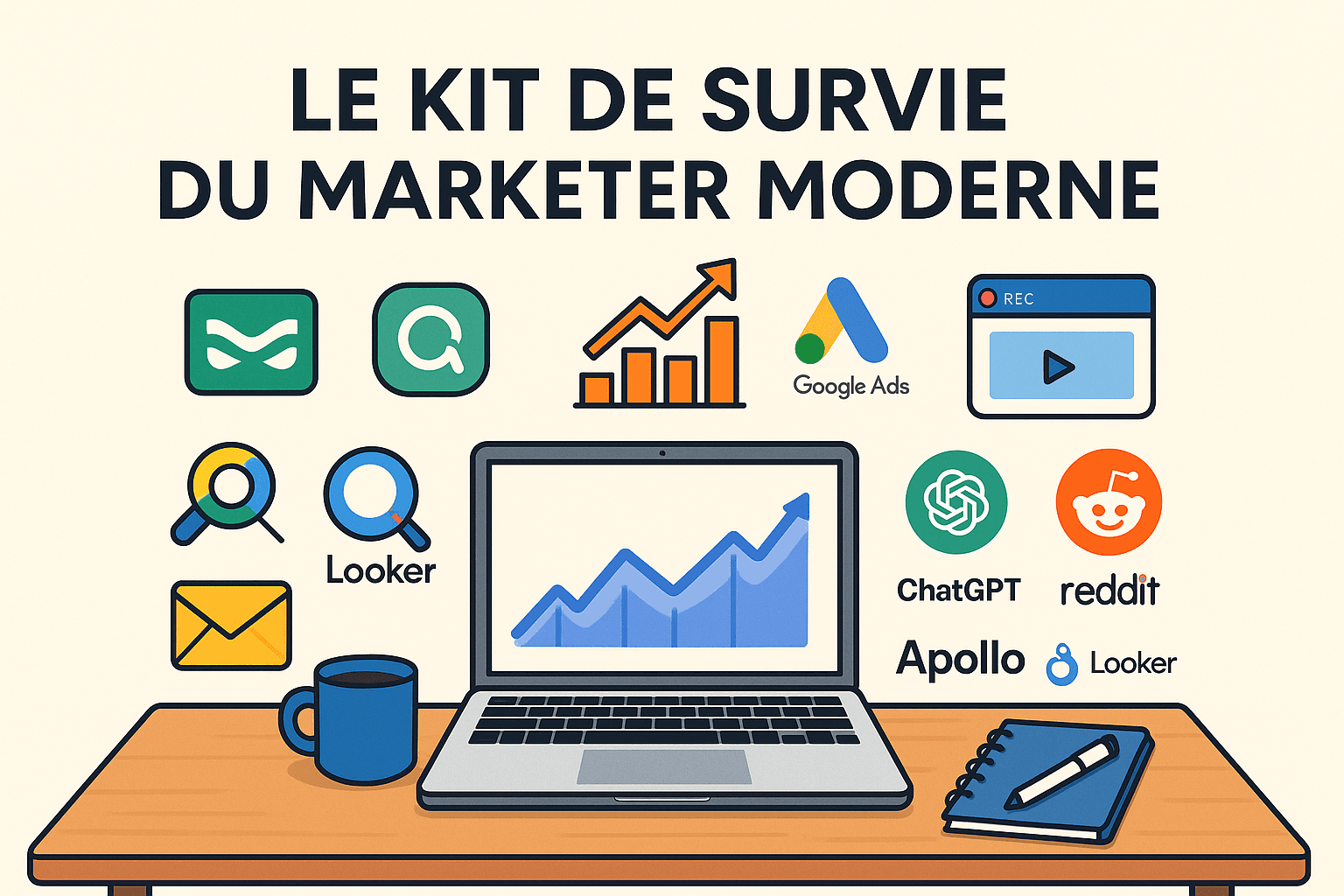
The mastery of marketing tools has become an essential skill for anyone looking to succeed in this field. Whether it’s about acquiring new customers, optimizing advertising campaigns, or managing complex projects, the right tools not only enhance efficiency but also amplify the impact of every action taken. In this article, I want to share with you the 10 marketing tools that I use most frequently in 2026. My goal is simple: to provide you with a practical and concrete guide to accelerate your skill development, whether you are at the beginning of your career or looking for new levers to improve your performance.
Klaviyo
Klaviyo is my favorite platform for email marketing 📧. I love its simple interface and powerful automations. For example, it’s easy to create a personalized customer journey: a customer abandons their cart? Boom, they automatically receive a personalized follow-up email. With Klaviyo, I set up highly advanced segmentation campaigns for an e-commerce site, which optimized the CRO by 35% in 3 months.
What’s great is the ease of integration with Shopify or Magento. You can retrieve customer data in real-time and trigger hyper-targeted sequences. During a Black Friday campaign, I segmented buyers based on their tenure and average cart value, which doubled the revenue compared to the previous year.
GA4 (Google Analytics 4)
Even though I find GA4 not the easiest to use, it is now essential for analyzing data 📊. In a recent project, I used GA4 to precisely track visitor actions on a landing page, which allowed me to optimize the conversion rate by +20%.
It is crucial to understand the logic of “events.” For example, I set up a distinct “add to cart” event separate from a simple “click on product” to better understand where my visitors drop off. Thanks to “custom funnels,” I was able to diagnose that one step in the checkout was causing a 15% loss in conversions for a SaaS client.
Looker (formerly Data Studio)
Looker is essential for visualizing and understanding marketing data. For example, I built a dashboard combining GA4, Search Console, and Google Ads to track the SEO and SEA performance of an e-commerce site in real-time 📈.
Looker allows you to transform raw data into clear and readable graphs. In an email marketing project, I cross-referenced open rates by audience segment and type of offer, which helped redefine our content strategy. Using dynamic graphs also greatly helps convince management teams with readable data.
Google Ads
Google Ads is the ideal tool for quickly generating your first leads or sales. For example, I launched a Google Ads campaign targeting only the keywords “buy + product,” which allowed me to achieve sales within the first few days.
I always prioritize “search” campaigns before moving to display or YouTube, as the quality of leads is much better. I also had excellent results using combined remarketing audiences with dynamic ad extensions, which allows displaying the right message to the right person.
Frizerly
Frizerly is an incredible AI solution for automatically publishing SEO content ✍️ on a website. For one of my clients in SaaS, Frizerly generated over 300 articles in a year, boosting their organic traffic by 45% without daily human effort.
For example, we set up Frizerly to publish optimized articles around frequently asked questions from its customers. This allowed us to occupy more zero positions in Google. To maximize the impact, we complemented the AI by adding internal backlinks ourselves in the published articles.
Asana
Asana is one of the best tools I’ve used for managing marketing projects. Every time I launch an email campaign, I create an Asana project with subtasks for each step: writing, design, approval, sending.
For a product launch, I also used Asana to organize the entire marketing roadmap: creating visuals, video scripts, launching the site, and the launch campaign. Being able to clearly assign responsibilities to each team member reduces the risk of forgetting and wasting time.
Apollo
Apollo is my secret weapon for B2B prospecting. In a previous position, I built a cold emailing campaign that generated over 100 meetings in two months thanks to Apollo.
I mainly use it to quickly obtain quality leads, with hyper-precise filters on job title, company, and location. For example, in a niche market like European fintechs, Apollo allowed me to reach the right decision-makers directly, without needing much more expensive tools like ZoomInfo.
Loom
Loom is my favorite tool for asynchronous communication. When I brief a freelancer, instead of writing a long email, I record a short video where I directly show the screen and explain what I expect.
I also use it internally to record mini-trainings on tools or processes: for example, a Loom video explaining how to correctly tag campaigns in GA4 helped the entire marketing team avoid costly mistakes.
ChatGPT
ChatGPT is my daily virtual assistant. When I need to transform a mass of notes into a clear article plan, I use it. When I prepare for a job interview, I ask it to simulate interview questions.
In marketing, I use it to refine customer personas, create lists of blog topic ideas, or quickly analyze competing advertisements. In a recent project, ChatGPT also helped me establish a six-month content plan for a B2B site.
Reddit is a goldmine for understanding what consumers really think. To prepare for a product launch, I often read discussion threads where users talk about needs, frustrations, or competitors.
In a brand repositioning campaign, I used Reddit to identify new expectations in our market segment, which allowed us to correct our message before even testing it on paid channels. Reddit is also a fantastic source of ideas for creating content that truly addresses your audience’s questions.
Conclusion
Diving into marketing can seem daunting given the vast array of technical skills to acquire and tools available. However, with a structured approach and the wise use of the right tools, it is possible to build an effective marketing strategy 🚀, even with limited resources. The 10 tools I presented in this article are not just technical solutions. They have become, over the years, true pillars of my professional daily life. From project management with Asana, to detailed data analysis via GA4 and Looker, to traffic acquisition through Google Ads or B2B prospecting with Apollo, each plays a key role in achieving my goals. It is essential to keep in mind that these tools do not replace strategic thinking, creativity, or a deep understanding of your audience. They enhance them. When used wisely, they can become powerful accelerators of growth and impact. I encourage you to experiment, test, learn from your mistakes, and continuously refine your practice. Marketing is a field of ongoing learning where curiosity, rigor, and the desire to progress will always make a difference.
If you have other tools that you use daily, or if you want to share your experiences, feel free to contact me. It is by sharing our knowledge that we grow our discipline.